Question
Solve for x and y:
$\text{x}+\frac{5}{\text{y}}=\text{6},$
$\text{3x}-\frac{8}{\text{y}}=\text{5}\ (\text{y}\neq0).$

Answer

The given equations are $\text{x}+\frac{6}{\text{y}}=6$ and $\text{3x}-\frac{8}{\text{y}}=5$ Putting $\frac{1}{\text{y}}=\text{x}$ the given equations become x + 6v = 6 ...(1) 3x - 8v = 5 ...(2)Multiplying (1) by 4 and (2) by 3, we get
4x + 24v = 24 ...(3)
9x - 24v = 15 ...(4)
Adding (3) and (4), we get
13x = 24 + 15 = 39
$\therefore\text{x}=\frac{39}{13}=3$Putting x = 3 in (1), we get
$3+\text{6v}=6$ $\therefore\text{6v}=6-3=3$ $\text{v}=\frac{3}{6}=\frac{1}{2}$ $\text{v}=\frac{1}2{}$ $\Rightarrow\frac{1}{\text{y}}=\frac{1}{2}$ $\Rightarrow\text{y}=2$$\therefore$ The solution is x = 3 and y = 2

Need a full question paper?

Generate a complete, print-ready paper with questions like this in minutes — across 16+ boards, with answer keys.
Start Generating Free

Similar questions

How many three digit numbers are divisible by 7?
A cylinder, a cone and a hemisphere are of equal base and have the same height. What is the ratio of their volumes?
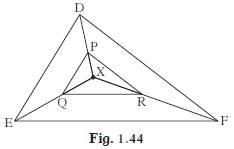
In the figure 1.44, X is any point in the interior of triangle. Point X is joined to vertices of triangle. Seg PQ || seg DE, seg QR || seg EF. Fill in the blanks to prove that, seg PR || seg DF.

Proof: IN $\triangle XDE , PQ \| DE$ $\square$
$\therefore \frac{ XP }{\square}=\frac{\square}{ QE }$
(Basic proportionality theorem)
In $\triangle XDE , QR \| EF......... \square$
$\therefore$ $\frac{\square}{\square}=\frac{\square}{\square}...............(ii)\square$
$\therefore$ $\frac{\square}{\square}=\frac{\square}{\square}...............$ from (i) and (ii)
$\therefore \text { seg PR\|seg DE .......... }$
(converse of basic proportionality theorem)
Evaluate the following:
$\sin^230^\circ\cos^245^\circ+4\tan^230^\circ+\frac{1}{2}\sin^290^\circ-2\cos^290^\circ+\frac{1}{24}\cos^20^\circ$
The surface area of a sphere is the same as the curved surface area of a cone having the radius of the base as 120cm and height 160cm. Find the radius of the sphere.
Find the zeros of the following quadratic polynomial and verify the relationship between the zeros and the coefficients:
$x^2 + 7x + 12$
The sum of four consecutive numbers in A.P. is 32 and the ratio of the product of the first and last terms to the product of two middle terms is 7 : 15. Find the number.
Find the value of a and b for which the following systems of linear equations has an infinite number of solutions:
$(2a - 1)x + 3y = 5,$
$3x + (b - 1)y = 2$
A hollow sphere of internal and external diameters 4cm and 8cm respectively is melted into a cone of base diameter 8cm. Calculate the height of the cone.