Question
Solve graphically : 2y – 5 ≥ 0

Answer

Consider the line whose equation is $2 y-5=0$, i.e. $y=\frac{5}{2}$

This represents a line parallel to $X$-axis passing through the point $\left(0, \frac{5}{2}\right)$.

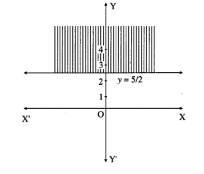
Draw the line $y=\frac{5}{2}$.

To find the solution set, we have to check the position of the origin (0, 0). When y = 0, 2y – 5 = 2 × 0 – 5 = -5 ≱ 0 ∴ the coordinates of the origin does not satisfy the given inequality.

$\therefore$ the solution set consists of the line $y=\frac{5}{2}$ and the non-origin side of the line which is

shaded in the graph.
Image

Need a full question paper?

Generate a complete, print-ready paper with questions like this in minutes — across 16+ boards, with answer keys.

Start Generating Free

Similar questions

Find f(x) is continuse at x = 0, then $\text{f(x)}=\frac{\text{x}}{1-\sqrt{1-\text{x}}}$ becomes continuous at x = 0.
If $A B C D E F$ is a regular hexagon, show that $\overline{\mathrm{AB}}+\overline{\mathrm{AC}}+\overline{\mathrm{AD}}+\overline{\mathrm{AE}}+\overline{\mathrm{AF}}=6 \overline{\mathrm{AO}}$, where $\mathrm{O}$ is the center of the hexagon.
Show that the four points having position vectors
$6\hat{\text{i}}-7\hat{\text{j}},16\hat{\text{i}}-19\hat{\text{j}}-4\hat{\text{k}},3\hat{\text{j}}-6\hat{\text{k}},2\hat{\text{i}}+5\hat{\text{j}}+10\hat{\text{k}}$ are not coplanar.
If $\tan ^{-1} x +\tan ^{-1} y +\tan ^{-1} z =\pi$, then show that $\frac{1}{x y}+\frac{1}{y z}+\frac{1}{z x}=1$
In $\Delta A B C$, if $a \cos A=b \cos B$ then prove that the triangle is either a right angled or an isosceles triangle.
Find the equation of the plane passing through the following point:
(-5, 0, -6), (-3, 10, -9) and (-2, 6, -6)
Find the mean and variance of the number randomly selected from $1$ to $15$
If $\big[3\vec{\text{a}}+7\vec{\text{b}}\vec{\text{c}}\vec{\text{d}}\big]=\lambda\big[\vec{\text{a}}\vec{\text{c}}\vec{\text{d}}\big]+\mu\big[\vec{\text{b}}\vec{\text{c}}\vec{\text{d}}\big],$ then find the value of $\lambda+\mu.$
Obtain the differential equation by eliminating the arbitrary constants from the following equations:

$y=e^{-2 x}(A \cos x+B \sin x)$

Express $-\bar{i}-3 \bar{j}+4 \bar{k}$ as a linear combination of vectors $2 \bar{i}+\bar{j}-4 \bar{k}, 2 \bar{i}+3 \bar{k}$ and $3 \bar{i}+\bar{j}-2 \bar{k}$