Question
Solve graphically that the following system of equation has infinitely many solutions:
$3x + y = 8$
$6x + 2y = 16$

Answer

The given equations are,
$3x + y = 8 .......(i)$
$6x + 2y = 16 ........(ii)$
From $(i), y = 8 - 3x .......(iii)$
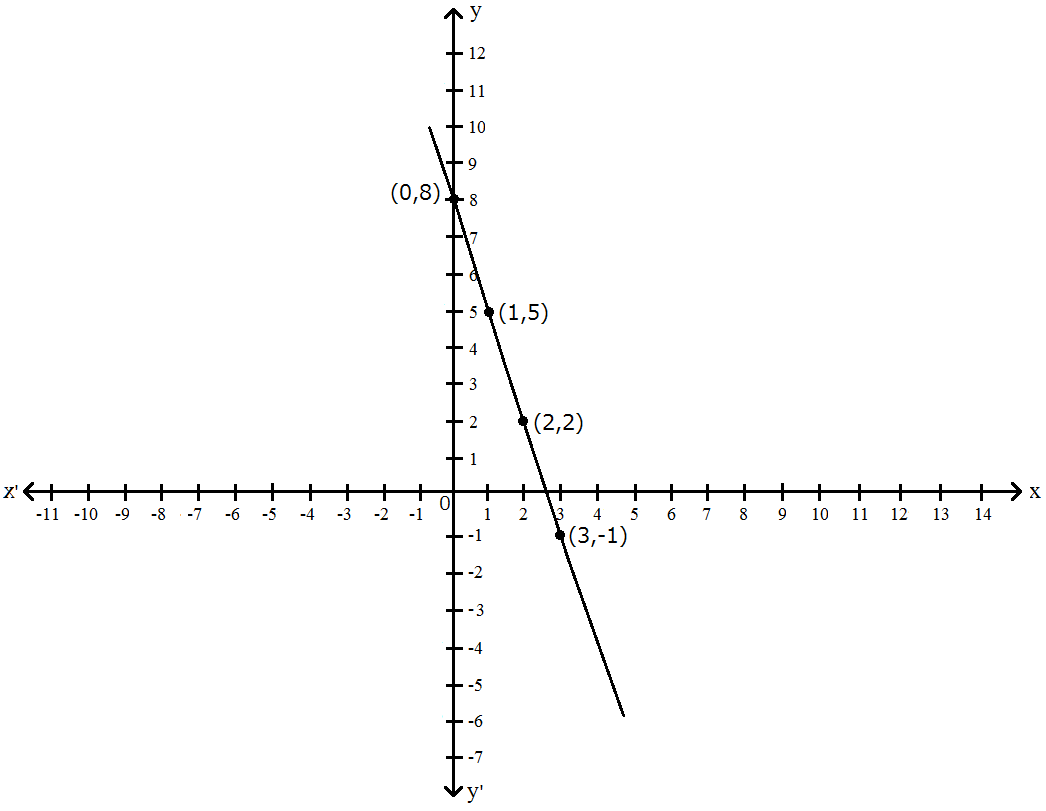
Putting $x = 0$ in $(iii)$, we get $y = 8$
Putting $x = 1$ in $(iii)$, we get $y = 5$
Putting $x = 2$ in $(iii)$, we get $y = 2$
$x$
$0$
$1$
$2$
$y$
$8$
$5$
$2$
From $(ii)$, $\text{y}=\frac{16-6\text{x}}{2}\ .....(\text{iv})$
Putting $x = 1$ in $(iv)$, we get $y = 5$
Putting $x = 2$ in $(iv)$, we get $y = 2$
Putting $x = 3$ in $(iv)$, we get $y = -1$
$x$
$1$
$2$
$3$
$y$
$5$
$2$
$-1$


When we polt these points on graph paper we observe that all then points on a line so the given system of equations has infinitaly many solutions.

Need a full question paper?

Generate a complete, print-ready paper with questions like this in minutes — across 16+ boards, with answer keys.
Start Generating Free

Similar questions

If $\alpha$ and $\beta$ are the zeroes of the quadratic polynomial $f(x) = x^2+ px + q,$ find a quadratic polynomial whose zeroes are $(\alpha+\beta)^2$ and $(\alpha-\beta)^2.$
Prove that $\big(5-2\sqrt3\big)$ is an irrational number.
 Five cards—the ten, jack, queen, king and ace of diamonds, are well-shuffled with their face downwards. One card is then picked up at random.
  1. What is the probability that the card is the queen?
  2. If the queen is drawn and put aside, what is the probability that the second card picked up is
    1. an ace?
    2. a queen?
Prove that if a positive integer is of the form $6q + 5$, then it is of the form $3q + 2$ for some integer q, but not conversely.
Solve for $x$ and $y$:
$\frac{5}{\text{x}}+\text{6y}=13,$
$\frac{3}{\text{x}}+\text{4y}=7\ (\text{x}\neq0).$
If a line is drawn parallel to one side of a triangle to intersect the other two sides in distinct points, the other two sides are divided in the same ratio.
Find the length of the medians of a $\triangle ABC$ having vertices at $A(0, -1), B(2, 1)$ and $C(0, 3).$
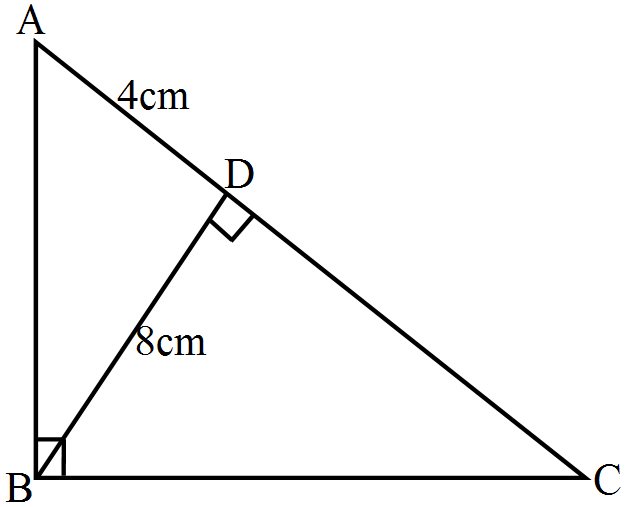
In the given figure, $\angle ABC =90^{\circ}$ and $BD \perp AC$. If $BD =8 cm, AD =4 cm$, find $CD .$
Short-Answer Question:
If $\alpha$ and $\beta$ are the zeroes of a polynomial $f(x) = x^2- 5x + k,$ such that $\alpha-\beta=1$ find the value of k.
Draw a $\triangle\text{ABC},$ right-angled at $B$ such that $AB = 3\ cm$ and $BC = 4\ cm$. Now, Construct a triangle a triangle similar to $\triangle\text{ABC},$ each of whose sides is $\frac75\text{times}$ the correponding side of $\triangle\text{ABC}.$