Question
Solve graphically the following linear programming problem:
Maximise $z = 6x + 3y,$
Subject to the constraints:
$4 x+y \geq 80$
$3 x+2 y \leq 150$
$x+5 y \geq 115$
$x > 0, y \geq 0$
Answer

Subject to the constraints are
$4 x+y \geq 80$
$x+5 y \geq 115$
$3 x+2 y \leq 150$
and the non negative constraint $x, y \geq 0$
Converting the given inequations into equations,
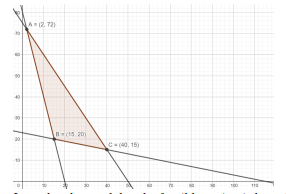
we get $4x + y = 80 x + 5y = 115 3x + 2y = 150 x = 0$ and $y = 0$ These lines are drawn on the graph and the shaded region $\text{ABC}$ represents the feasible region of the given $LPP.$
Image
It can be observed that the feasible region is bounded. The coordinates of the corner points of the feasible region are $A(2, 72) B(15, 20)$ and $C(40,15)$ The values of the objective function, $Z$ at these corner points are given in the following table:
Corner Point Value of the Objective Function $z = 6x + 3y$
$ A (2,72): Z=6 \times 2+3 \times 72=228$
$B(15,20): Z=6 \times 15+3 \times 20=150$
$C (40,15): Z=6 \times 40+3 \times 15=285$
From the table, $Z$ is minimum at $x = 15$ and $y = 20$ and the minimum value of $Z$ is $150$. Thus, the minimum value of $Z$ is $150$

Need a full question paper?

Generate a complete, print-ready paper with questions like this in minutes — across 16+ boards, with answer keys.

Start Generating Free

Similar questions

Prove that $\int_a^b f(a+b-x) d x=\int_a^b f(x) d x$ and using it find $\int_4^9 \frac{f(x)}{f(x)+f(13-x)} d x$.
Evaluate the following integrals:
$\int\frac{1}{\text{x}\sqrt{\text{x}^4-1}}\text{ dx}$
Consider the binary operations * : R × R  → R and o : R × R → R defined as a * b = | a – b | and a o b = a for all a, b $\in$ R. Show that '*' is commutative but not associative, 'o' is associative but not commutative.
Integrate the function in Exercise:
$\frac{\sin\text{x}}{\sin(\text{x}-\text{a)}}$
Prove that $\sin^{–1} \Bigg(\frac{8}{17}\Bigg)+\sin^{-1}\Bigg(\frac{3}{5}\Bigg)=\cos^{-1}\Bigg(\frac{36}{85}\Bigg).$
Find the area of the parallelogram whose diagonals are:
$4\hat{\text{i}}-\hat{\text{j}}-3\hat{\text{k}}$ and $-2\hat{\text{i}}+\hat{\text{j}}-2\hat{\text{k}}$
Prove that $\left[\begin{array}{lll}\overrightarrow{\mathrm{a}}+\overrightarrow{\mathrm{b}} & \overrightarrow{\mathrm{b}}+\overrightarrow{\mathrm{c}} & \overrightarrow{\mathrm{c}}+\overrightarrow{\mathrm{a}}\end{array}\right]=2\left[\begin{array}{ll}\overrightarrow{\mathrm{a}} & \overrightarrow{\mathrm{b}} \overrightarrow{\mathrm{c}}\end{array}\right]$.
Probality of solving specific problem independently by $A$ and $B$ are $\frac{1}{2}$ and $\frac{1}{3}$ respectively. If both try to solve the problem independently. Find the probability that the problem is solved.
Evaluate the following integrals:
$\int^\limits{\frac{\pi}{2}}_{0}|\cos2\text{x}|\text{dx}$
Solve the following differential equation
$\text{x}\frac{\text{dy}}{\text{dx}}+\cot\text{y}=0$