Question
Solve $\left(\frac{x}{x+2}\right)^2-7\left(\frac{x}{x+2}\right)+12=0 ; x \neq-2$

Answer

$\left(\frac{x}{x+2}\right)^2-7\left(\frac{x}{x+2}\right)+12=0 ; x \neq-2$
Let $\frac{x}{x+2}=y$
then $y^2-7 y+12=0$
$\Rightarrow y^2-4 y-3 y+12=0 $
$\Rightarrow y(y-4)-3(y-4)=0$
then $y = 4$ and $y = 3$
$\Rightarrow \frac{x}{x+2}=4 \text { and } \frac{x}{x+2}=3$
$ \Rightarrow \frac{x}{x+2}=4 \text { and } \frac{x}{x+2}=3$
$\Rightarrow4 x +8= x \text { and } 3 x +6= x $
$\Rightarrow x=\frac{-8}{3} \text { and } x=-3$

Need a full question paper?

Generate a complete, print-ready paper with questions like this in minutes — across 16+ boards, with answer keys.
Start Generating Free

Similar questions

If $(a – b): (a + b) = 1: 11,$ find the ratio $(5a + 4b + 15): (5a – 4b + 3).$
Prove that the circle drawn on any one of the equal sides of an isosceles triangle as diameter bisects the base.
Solve each of the following equations using the formula:
$\frac{2}{3} x=-\frac{1}{6} x^2-\frac{1}{3}$
If $\left.A=\left[\begin{array}{ll}1 & 4 \\ 2 & 1\end{array}\right], B=\left[\begin{array}{cc}-3 & 2 \\ 4 & 0\end{array}\right]\right]$ and $C=\left[\begin{array}{ll}1 & 0 \\ 0 & 2\end{array}\right]$ Simplify $A^2+B C$
Find the sum of first $51$ terms of an A.P. whose $2$nd and $3$rd terms are $14$ and $18$ respectively.
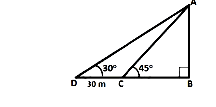
In the figure, given below, it is given that $AB$ is perpandiculer to $BD$ and is of length $X$ metres. $DC = 30m .\angle ADB = 30^\circ$ and $\angle ACB = 45^\circ . $Without using tables, find $X$​​​​​​​
The sides of a triangle are in the ratio 7 : 5 : 3 and its perimeter is 30 cm. Find the lengths of sides.
If $A=\left[\begin{array}{cc}2 & a \\ -3 & 5\end{array}\right]$ and $B=\left[\begin{array}{cc}-2 & 3 \\ 7 & b\end{array}\right], C=\left[\begin{array}{cc}c & 9 \\ -1 & -11\end{array}\right]$ and $5 A+2 B=C$, find the values of $a, b, c$
Find the range of values of a, which satisfy $7 \leq – 4x + 2 < 12, x \in R.$ Graph these values of a on the real number line.
Determine the matrices $A$ and $B$ when $A+2 B=$
$
\left[\begin{array}{cc}
1 & 2 \\
6 & -3
\end{array}\right] \text { and } 2 A - B =\left[\begin{array}{cc}
2 & -1 \\
2 & -1
\end{array}\right]
$