Question
Solve $: - m + (3m - 6m) = - 8 - 14$

Answer

$-m+(3 m-6 m)=-8-14$
$\Rightarrow-m+3 m-6 m=-8-14$
$\Rightarrow-7 m+3 m=-22$
$\Rightarrow-4 m=-22$
$\Rightarrow m=\frac{-22}{-4}$
$\Rightarrow m=\frac{11}{2}$
$\Rightarrow m=5 \frac{1}{2}$

Need a full question paper?

Generate a complete, print-ready paper with questions like this in minutes — across 16+ boards, with answer keys.

Start Generating Free

Similar questions

Arrange the given fractions in ascending order of magnitude:
$\frac{5}{6}, \frac{2}{7}, \frac{8}{9}, \frac{1}{3}$
In buying a ready-made shirt-two-fifths of my pocket money is spent If Rs. 540 is still left with me, find:
(i) The money I had before I bought the shirt.
(ii) The emit of the shirt
Find the L.C.M. of the following numbers using prime factorisation method :
36, 45
A drum of kerosene is $\frac{3}{4}$ full. When 30 litres of kerosene is drawn from it, it remains $\frac{7}{12}$ full.
Q.1. The capacity of the drum is :
(a) 120 $l$$\quad$(b) 150 $l$$\quad$(c) 180 $l$$\quad$(d) 168 $l$
Q.2. The quantity of kerosene in the drum is :
(a) 135 $l$$\quad$(b) 115 $l$$\quad$(c) 125 $l$$\quad$(d) 108 $l$
Q.3. If 15 $l$ of kerosene is added to the drum, what fraction of the capacity would be filled?
(a) $\frac{1}{2}$$\quad$(b) $\frac{2}{3}$$\quad$(c) $\frac{5}{6}$$\quad$(d) $\frac{5}{12}$
Q.4. If 35 $l$ of kerosene is drawn from the drum, what fraction of the capacity would be filled?
(a) $\frac{5}{9}$$\quad$(b) $\frac{7}{9}$$\quad$(c) $\frac{11}{18}$$\quad$(d) $\frac{13}{18}$
Construct a triangle PQR in which, PQ = QR = RP = 5.7 cm. Draw the incircle of the triangle and measure its radius.
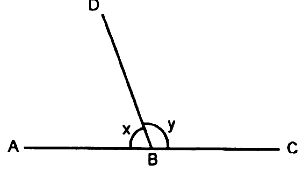
In the given diagram, $ABC$ is a straight line. If $y =1 \frac{1}{2}$
right angles; find $x.$
Simplify:
$4 \frac{2}{3} \div\left(3-\frac{1}{2}\right)+\left(\frac{2}{5} \div 1 \frac{1}{5}\right)$
As per the census of India 2011, the urban population of Punjab, Uttar Pradesh and Madhya Pradesh was recorded as (1,03,99,146), (4,44,95,063) and (2,11,69,405) respectively.
Q.1. The urban population of Madhya Pradesh was :
(a) Twenty one crore one hundred sixteen lakh nine thousand four hundred five
(b) Twenty one crore eleven lakh nine thousand four hundred five.
(c) Two crore eleven lakh sixty nine thousand four hundred five
(d) None of these
Q.2. The urban population of Madhya Pradesh exceeded that of Punjab by:
(a) 1,70,70,259$\quad$ (b) 1,07,70,259$\quad$ (c) 10,77,259$\quad$ (d) None of these
Q.3. The total urban population of the three states was :
(a) 7,06,63,614$\quad$ (b) 1,60,66,314$\quad$ (c) 7,60,63,614$\quad$ (d) 7,63,60,614
Q.4. The urban population of Uttar Pradesh rounded to the nearest lakh is:
(a) 4,45,00,000$\quad$(b) 4,44,90,000$\quad$ (c) 4,44,96,000$\quad$ (d) 4,44,00,000
Three angles of a quadrilateral are equal and the fourth angle measures $120^{\circ}$. What is the measure of each of the equal angles?
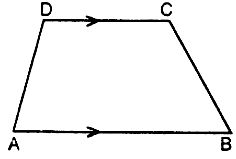
The following figure shows a quadrilateral in which sides AB and DC are parallel. If ∠A : ∠D = 4 : 5, ∠B = (3x – 15)° and ∠C = (4x + 20)°, find each angle of the quadrilateral ABCD.