Question
Solve: $\frac{\text{ax}}{\text{b}}-\frac{\text{by}}{\text{a}}=\text{a}+\text{b},$ $\text{ax}-\text{by}=\text{2ab}.$
Answer

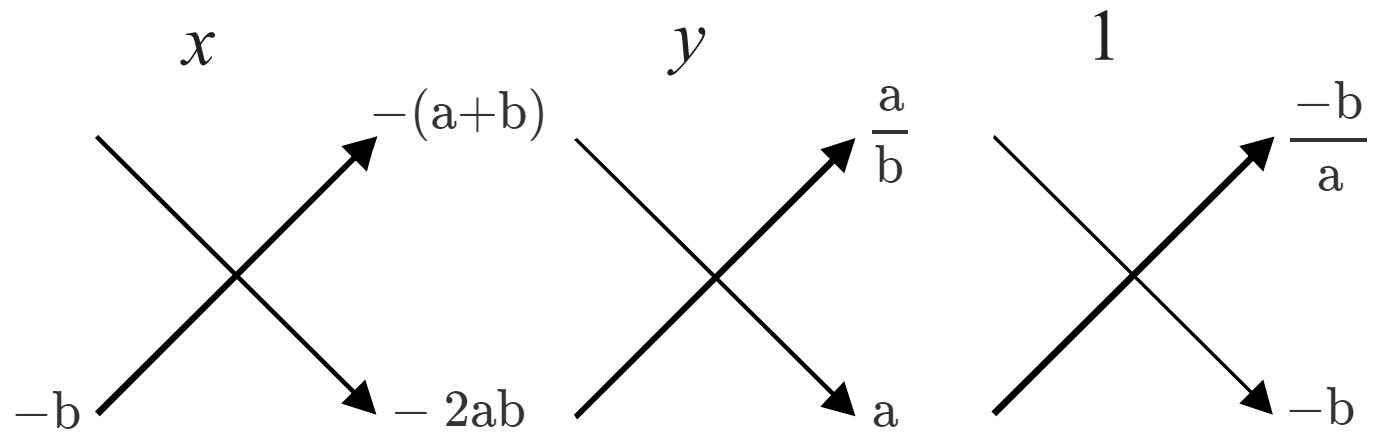
The given equation may be written as follows: $\frac{\text{ax}}{\text{b}}-\frac{\text{by}}{\text{a}}-(\text{a+b})=0\ ...(\text{i})$ ax - by - 2ab = 0 ...(ii) Here, $\text{a}_1=\frac{\text{a}}{\text{b}},\ \text{b}_1=\frac{\text{b}_1}{\text{a}},$ $\text{c}_1=-(\text{a+b}),\ \text{a}_2=\text{a},$ $\text{b}_2= -\text{b},\ \text{c}_2=-2\text{ab}$ By cross multiplying, we have:
$\therefore\frac{\text{x}}{\big(-\frac{\text{b}}{\text{a}}\big)\times(-2\text{ab})-(-\text{b})\times(-(\text{a+b}))}\\\ \ \ =\frac{\text{y}}{-(\text{a+b})\times\text{a}-(-2\text{ab})\times\frac{\text{a}}{\text{b}}}\\\ \ \ =\frac{1}{\frac{\text{a}}{\text{b}}\times(-\text{b})-\text{a}\times\big(-\frac{\text{b}}{\text{a}}\big)}$ $\Rightarrow\frac{\text{x}}{2\text{b}^2-\text{b}(\text{a+b})}=\frac{\text{y}}{-(\text{a+b})+2\text{a}^2}=\frac{1}{-\text{a+b}}$ $\Rightarrow\frac{\text{x}}{2\text{b}^2-\text{ab}-\text{b}^2}=\frac{\text{y}}{-\text{a}^2-\text{ab}+2\text{a}^2}=\frac{1}{-\text{a+b}}$ $\Rightarrow\frac{\text{x}}{\text{b}^2-\text{ab}}=\frac{\text{y}}{\text{a}^2-\text{ab}}=\frac{1}{-(\text{a}-\text{b})}$ $\Rightarrow\frac{\text{x}}{-\text{b}(-\text{a}-\text{b})}=\frac{\text{y}}{\text{a}(\text{a}-\text{b})}=\frac{1}{-(\text{a}-\text{b})}$ $\Rightarrow\text{x}=\frac{-\text{b}(\text{a}-\text{b})}{-(\text{a}-\text{b})}=\text{b},\ \text{y}=\frac{\text{a}(\text{a}-\text{b})}{-(\text{a}-\text{b})}=-\text{a}$ Hence, x = b and y = -a is the required solution.

Need a full question paper?

Generate a complete, print-ready paper with questions like this in minutes — across 16+ boards, with answer keys.

Start Generating Free

Similar questions

​The following table shows the marks scored by 80 students in an examination:
Marks
Less than 5
Less than 10
Less than 15
Less than 20
Less than 25
Less than 30
Less than 35
Less than 40
Number of students
3
10
25
49
65
73
78
80
Calculate the mean marks correct to 2 decimal places.
Solve the following systems of equations by using the method of cross multiplication:
$\text{7x}-\text{2y}=3,$
$\text{11x}-\frac{3}{2}\text{y}=8$
Solve for x and y:
4x + 6y = 3xy,
8x + 9y = 5xy $(\text{x}\neq0,\ \text{y}\neq0).$
Find the roots of the following equation, if they exist, by applying the quadratic formula:
$4x^2 - 4a^2x + (a^4 - b^4) = 0$
Solve the following systems of equations by using the method of cross multiplication:
$2ax + 3by = (a + 2b),$
$3ax + 2by = (2a + b).$
In the given figure, $PQ =24 cm, PR =7 cm$ and $O$ is the centre of the circle. Find th area of the shaded region.. $\big[\text{Take }\pi=3.14\big]$
Each of the equal sides of an isosceles triangle measures 2cm more than its height, and the base of the triangle measures 12cm. Find the area of the triangle.
Prove that $\big(2\sqrt3-1\big)$ is an irrational number.
In the given fingure, $\triangle\text{ABC}$ is right-angled at A. semicircles are drawn on AB, AC and BC as diameter, it is given that AB = 3cm and AC = 4cm. find the area of the shaded region.
There are two classrooms A and B. If 10 students are sent from A to B, the number of students in each room becomes the same. If 20 students are sent from B to A, the number of students in A becomes double the number of students in B. Find the number of students in each room.