Question
Solve the equation $3x^2 – x – 7 = 0$ and give your answer correct to two decimal places.

Answer

$3 x^2-x-7=0 $
$ a=3, b=-1, c=-7$
$x=\frac{-b \pm \sqrt{b^2-4 a c}}{2 a} $
$ =-\frac{(-1) \pm \sqrt{(-1)^2-4.3 \cdot(-7)}}{2 \times 3} $
$ =\frac{1 \pm \sqrt{1+84}}{6} $
$ =\frac{1 \pm \sqrt{85}}{6}$
$ =\frac{1 \pm 9 \cdot 216}{6}$
$x=\frac{1+9.216}{6} \text { and } \frac{1-9.216}{6} $
$=\frac{10.216}{6} \text { and }-\frac{8.216}{6}$
$= 1.703$ and $-1.37$

Need a full question paper?

Generate a complete, print-ready paper with questions like this in minutes — across 16+ boards, with answer keys.

Start Generating Free

Similar questions

Draw two intersecting lines to include an angle of 30º. Use ruler and compasses to locate points which are equidistant from these lines and also 2 cm away from their point of intersection. How many such points exist?
If (a + b + c + d) (a – b – c + d) = (a + b – c – d) (a – b + c – d), prove that a: b = c: d.
A cone of height $15 cm$ and diameter $7 cm$ is mounted on a hemisphere of same diameter.Determine the volume of the solid thus formed.
A random survey of the number of children of various age groups playing in a park was found as follows:
Age (in years)No. of Children
1 - 25
2 - 33
3 - 56
5 - 712
7 - 109
10 - 1510
15 - 174
Draw a histogram to represent the above data.
Solve the following inequation, write down the solution set and represent it on the real number line:
$-2+10 x \leq 13 x+10<24+10 x, x \in Z$
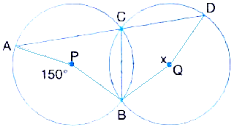
In the figure, given below, P and Q are the centres of two circles intersecting at B and C ACD is a straight line. Calculate the numerical value of x .
Image
Find mean by step$- $deviation method:
$C.I$ $63-70$ $70-77$ $77-84$ $84-91$ $91-98$ $98-105$ $105-112$
Freq $9$ $13$ $27$ $38$ $32$ $16$ $15$
 If $( x -2)$ is a factor of $2 x ^3- x ^2+ px -2$, then
(i) find the value of $p$.
(ii) with this value of $p$, factorise the above expression completely
Construct a triangle ABC, having given AB = 4.8 cm, AC = 4cm, and ∠A = 75°.
Find a point P.
(i) Inside the triangle ABC.
(ii) outside the triangle ABC
Equidistant from B and C; and at a distance of 1.2 cm from BC.

Find the equation of the line passing through $(−2, 1)$ and perpendicular to $4x + 5y = 6.$