Question
Solve the following by reducing them to quadratic equations:
$x^4 - 26x2 + 25 = 0$

Answer

Given $x^4-26 x^2+25=0$
Putting $x^2=y$, the given equation reduces to the form $y^2-26 y+25=0$
$\Rightarrow y^2 - 25y - y + 25 = 0$
$\Rightarrow y(y - 25) -1(y- 25) = 0$
$\Rightarrow (y - 25) (y - 1) = 0$
$\Rightarrow y - 25 = 0$ or $y - 1 = 0$
$\Rightarrow y = 25$ or $y = 1$
$\therefore x^2 = 25$
$\Rightarrow x = ± 5$
or
$x^2 = 1$
$x = ±1$
Hence, the required roots are $\pm 5, \pm 1$.

Need a full question paper?

Generate a complete, print-ready paper with questions like this in minutes — across 16+ boards, with answer keys.
Start Generating Free

Similar questions

All the three face cards of spades are removed from a well shuffled pack of 52 cards. A card is then drawn at random from the remaining pack. Find the probability of getting:  a black card   
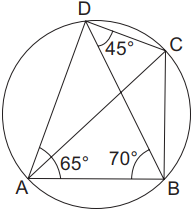
In the given figure, $\angle \mathrm{BAD}=65^{\circ}, \angle \mathrm{ABD}=70^{\circ}$ and $\angle \mathrm{BDC}=45^{\circ}$. Find
(a) $\angle \mathrm{BCD}$
(b) $\angle \mathrm{ADB}$. Hence, show that AC is a diameter of the circle.
Image
All the three face cards of spades are removed from a well shuffled pack of 52 cards. A card is then drawn at random from the remaining pack. Find the probability of getting : a queen.
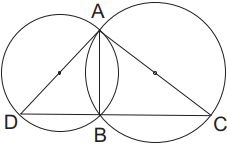
Two circles intersect at two points A and $\mathrm{B} . \mathrm{AD}$ and AC are diameters of the two circles. Prove that B lies on the line segment DC.
Image
For each inequality, determine which of the given numbers are in the solution set:
2x + 3 >11; -3, 4, 5, 7
Solve the following linear in-equation and graph the solution set on a real number line :
3x - 9 ≤ 4x - 7 < 2x + 5, x ∈ R
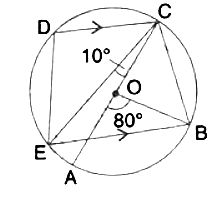
In the given figure, AC is the diameter of circle, centre $\mathrm{O} . \mathrm{CD}$ and BE are parallel. Angle $\mathrm{AOB}=80^{\circ}$ and angle $\mathrm{ACE}=$ $10^{\circ}$. Calculate : Angle BCD
Solve the following inequation and write down the solution set:
$11 x-4<15 x+4 \leq 13 x+14, x \in W$
Represent the solution on a real number line.
If (x – 9) : (3x + 6) is the duplicate ratio of 4 : 9, find the value of x.
Prove that $\frac{\cot A+\operatorname{cosec} A-1}{\cot A-\operatorname{cosec} A+1}=\frac{1+\cos A}{\sin A}$