Question
Solve the following differential equation $(1+\text{x}^2)\text{dy}=\text{xy dx}$

Answer

We have $(1+\text{x}^2)\text{dy}=\text{xy dx}$
$\Rightarrow\frac{1}{\text{y}}\text{dy}=\frac{\text{x}}{1+\text{x}^2}\ \text{dx}$
Integrating both sides, we get
$\int\frac{1}{\text{y}}\text{dy}=\int\frac{\text{x}}{1+\text{x}^2}\ \text{dx}$
Substituting $1+ x^2 = t,$ we get
$2\text{x dx}=\text{dt}$
$\therefore\int\frac{1}{\text{y}}\text{dy}=\frac{1}{2}\int\frac{1}{\text{t}}\text{dt}$
$\Rightarrow\log|\text{y}|=\frac{1}{2}\log|\text{t}|+\log\text{C}$
$\Rightarrow\log|\text{y}|=\frac{1}{2}\log|1+\text{x}^2|+\log\text{C}$
$\Rightarrow\log|\text{y}|=\log\Big[\text{C}\sqrt{1+\text{x}^2}\Big]$
$\Rightarrow\text{y}=\text{C}\sqrt{1+\text{x}^2}$
Hence $,\text{y}=\text{C}\sqrt{1+\text{x}^2}$ is the required solution.

Need a full question paper?

Generate a complete, print-ready paper with questions like this in minutes — across 16+ boards, with answer keys.
Start Generating Free

Similar questions

Differentiate the following function with respect to $x :(\log\text{x})^{x} + \text{x}^{\log\text{x}}.$
Evalute the following integrals:
$\int\frac{\cos4\text{x}-\cos2\text{x}}{\sin4\text{x}-\sin2\text{x}}\text{dx}$
Represent the following families of curves by forming the corresponding differential equation:
$\frac{\text{x}^2}{\text{a}^2}-\frac{\text{y}^2}{\text{b}^2}=1$
If y(t) is a solution of $(1+\text{t})\frac{\text{dy}}{\text{dt}}-\text{ty}=1$ and y(0) = -1, then show that $\text{y}(1)=-\frac{1}{2}.$
Mother, father and son line up at random for a family picture. If A and B are two events given by A = Son on one end, B = Father in the middle, find P (A/B) and P (B/A).
The function f(x) is befined as follows: $\text{f(x)}=\begin{cases}\text{x}^2+\text{ax}+\text{b},&0\leq\text{x}<2\\3\text{x}+2,&2\leq\text{x}\leq4\\2\text{ax}+5\text{b},&4<\text{x}\leq8\end{cases}$ if is continuous on [0, 8] find the value of a and b.
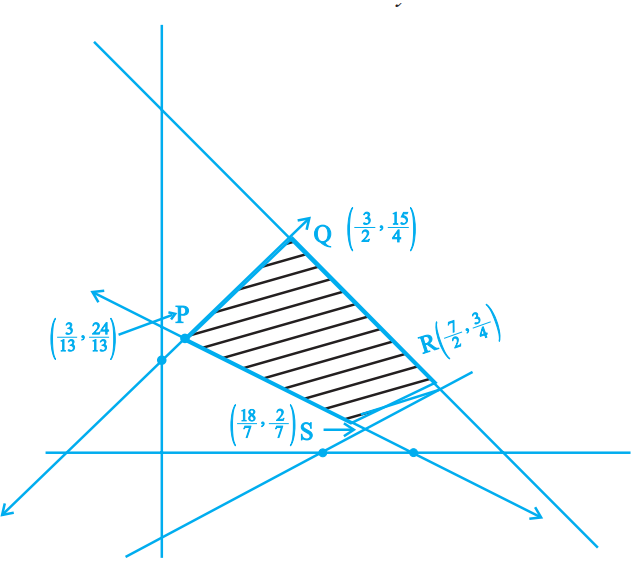
In the feasible region (shaded) for a LPP is shown. Determine the maximum and minimum value of Z = x + 2y.
A bag contains 10 balls, each marked with one of the digits from 0 to 9. If four balls are drawn successively with replacement from the bag, what is the probability that none is marked with the digit 0?
Check the commutativity and associativity of the following binary operations:
'*' on Q defined by $\text{a}\ ^*\ \text{b}=\frac{\text{ab}}{4}$ for all a, b ∈ Q.
If $A=\left[\begin{array}{ccc}2 & -3 & 5 \\ 3 & 2 & -4 \\ 1 & 1 & -2\end{array}\right]$ find $A^{-1}$, using $A^{-1}$ solve the system of equations
$2 x-3 y+5 z=11$
$3 x+2 y-4 z=-5$
$x+y-2 z=-3$