Question
Solve the following differential equation
$\sin^4\text{x}\frac{\text{dy}}{\text{dx}}=\cos\text{x}$

Answer

We have,
$\sin^4\text{x}\frac{\text{dy}}{\text{dx}}=\cos\text{x}$
$\Rightarrow\text{dy}=\frac{\cos\text{x}}{\sin^4\text{x}}\ \text{dx}$
Integrating both sides, we get
$\Rightarrow\int\text{dy}=\int\frac{\cos\text{x}}{\sin^4\text{x}}\ \text{dx}$
$\Rightarrow\text{y}=\int\frac{\cos\text{x}}{\sin^4\text{x}}\ \text{dx}$
Putting $\sin\text{x}=\text{t}$
$\Rightarrow\cos\text{x dx}=\text{dt}$
$\therefore\text{y}=\int\frac{1}{\text{t}^4}\ \text{dt}$
$=\frac{\text{t}^{-3}}{-3}+\text{C}$
$=\frac{-\sin^{-3}}{3}+\text{C}$
$=-\frac{1}{3}\text{cosec}^3\text{x}+\text{C}$
hence, $\text{y}=-\frac{1}{3}\text{cosec}^3\text{x}+\text{C}$ is the solution to the given differential equation.

Need a full question paper?

Generate a complete, print-ready paper with questions like this in minutes — across 16+ boards, with answer keys.
Start Generating Free

Similar questions

An urn contains 25 balls of which 10 balls bear a mark 'X' and the remaining 15 bear a mark 'Y'. A ball is drawn at random from the urn, its mark is noted down and it is replaced. If 6 balls are drawn in this way, find the probability that.
  1. All will bear 'X' mark.
  2. Not more than 2 will bear 'Y' mark.
  3. At least one ball will bear 'Y' mark.
  4. The number of balls with 'X' mark and 'Y' mark will be equal.​​​​​​​
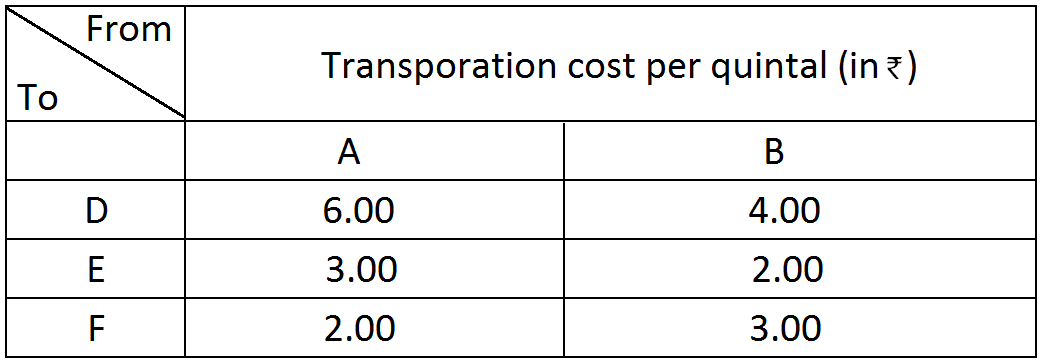
Tow godowns$, A$ and $B,$ have grain storage capacity of $100$ quintals and $50$ quintals respectively. They supply to $3$ ration shops$, D, E$ and $F,$ whose requirements are $60, 50$ and $40$ quintals respectively. The cost of transportation per quintal from the godowns to the shops are given in the following table:

How should the supplies be transported in order that the transportation cost is minimum? 
Find all points of discontinuity of $f,$ where $f$ is defined by: $\text{f(x)}= \begin{cases}\text{x}^{10} - 1,\ \ \text{if x}\leq 1 \\\text{x}^2,\ \ \ \ \ \ \ \ \ \ \text{if x}>1\end{cases}$ 
Find the area bounded by the lines y = 4x + 5, y = 5 - x and 4y = x + 5.
Prove that $\frac{\text{dy}}{\text{dx}}\Big\{\frac{\text{x}}{2}\sqrt{\text{a}^2-\text{x}^2}+\frac{\text{a}^2}{2}\sin^{-1}\frac{\text{x}}{\text{a}}\Big\}=\sqrt{\text{a}^2-\text{x}^2}$
A manufacturer can produce two products, A and B, during a given time period. Each of these products requires four different manufacturing operations: grinding, turning, assembling and testing. The manufacturing requirements in hours per unit of products A and B are given below.
 
A
B
Grinding
1
2
Turning
3
1
Assembling
6
3
Testing
5
4
The available capacities of these operations in hours for the given time period are: grinding 30; turning 60, assembling 200; testing 200. The contribution to profit is Rs 20 for each unit of A and Rs 30 for each unit of B. The firm can sell all that it produces at the prevailing market price. Determine the optimum amount of A and B to produce during the given time period. Formulate this as a LPP.
Show that the points A, B, C with position vectors $\vec{\text{a}}-2\vec{\text{b}}+3\vec{\text{c}},\ 2\vec{\text{a}}+3\vec{\text{b}}-4\vec{\text{c}}$ and $-7\vec{\text{b}}+10\vec{\text{c}}$ are collinear.
Evaluate the following integrals as limit of sum:
$\int\limits^{2}_{0}\big(3\text{x}^2-2\big)\text{dx}$
Minimise and Maximise Z = x + 2y
subject to $\text{x}+2\text{y}\geq100,\ 2\text{x}-\text{y}\leq0,\ 2\text{x}+ \text{y}\leq200;\ \text{x},\ \text{y}\geq0.$
Solve the following differential equation:
$(1+\text{x}^2)\frac{\text{dy}}{\text{dx}}+\text{y}=\text{e}^{\tan^{-1}\text{x}}$