Question
Solve the following differential equation:$4\frac{\text{dy}}{\text{dx}}+8\text{y}=5\text{e}^{-3\text{x}}$

Answer

$4\frac{\text{dy}}{\text{dx}}+8\text{y}=5\text{e}^{-3\text{x}}$
$\Rightarrow\ \frac{\text{dy}}{\text{dx}}+2\text{y}=\frac{5}4\text{e}^{-3\text{x}}\ \dots(1)$
Clearly, it is a linear differential equation of the form
$\frac{\text{dy}}{\text{dx}}+\text{Py}=\text{Q}$
$\text{P}=2$
$\text{Q}=\frac{5}4\text{e}^{-3\text{x}}$
$\therefore$ I.F. $=\text{e}^{\int\text{Pdx}}$
$=\text{e}^{\int2\text{dx}}$
$=\text{e}^{2\text{x}}$
Multiplying both sides of (1) by $\text{e}^{2\text{x}},$ we get
$\text{e}^{2\text{x}}\Big(\frac{\text{dy}}{\text{dx}}+2\text{y}\Big)=\frac{5}4\text{e}^{2\text{x}}\text{e}^{-3\text{x}}$
$\Rightarrow\ \text{e}^{2\text{x}}\frac{\text{dy}}{\text{dx}}+2\text{e}^{2\text{x}}\text{y}=\frac{5}4\text{e}^{-\text{x}}$
Integrating both sides with respect to x, we get
$\text{y}\text{e}^{2\text{x}}=\frac{5}4\int\text{e}^{-\text{x}}\text{dx + C}$
$\Rightarrow\ \text{y}\text{e}^{2\text{x}}=-\frac{5}4\text{e}^{-\text{x}}+\text{C}$
$\Rightarrow\ \text{y}=\frac{5}4\text{e}^{-3\text{x}}+\text{C}\text{e}^{-2\text{x}}$
Hence, $\text{y}=\frac{5}4\text{e}^{-3\text{x}}+\text{C}\text{e}^{-2\text{x}}$ is the required solution.

Need a full question paper?

Generate a complete, print-ready paper with questions like this in minutes — across 16+ boards, with answer keys.
Start Generating Free

Similar questions

Express the vector $\vec{\text{a}}=5\hat{\text{i}}-2\hat{\text{j}}+5\hat{\text{k}}$ as the sum of two vectors such that one is parallel to the vector $\vec{\text{b}}=3\hat{\text{i}}+\hat{\text{k}}$ and other is perpendicular to $\vec{\text{b}}.$
If the radius of a sphere is measured as 7m with an error of 0.02m, find the approximate error in calculating its volume.
Find the coordinates of the point where the line through the points A(3, 4, 1) and B(5, 1, 6) crosses the XZ plane. Also find the angle which this line makes with the XZ plane.
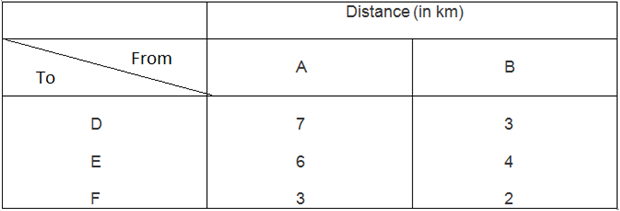
An oil company has two depots, $A$ and $B$, with capacities of $7000$ litres and $4000$ litres respectively. The company is to supply oil to three petrol pumps, $\text{D, E, F}$ whose requirements are $4500, 3000$ and $3500$ litres respectively. The distance $($in $\ km)$ between the depots and petrol pumps is given in the following table:

Assuming that the transportation cost per km is $Rs. 1.00$ per litre, how should the delivery be scheduled in order that the transportation cost is minimum?
Prove that the line through A(0, –1, –1) and B(4, 5, 1) intersects the line through C(3, 9, 4) and D(–4, 4, 4).
Evaluate the following integrals:
$\int\frac{\text{e}^{\text{x}}}{\text{x}}\Big\{\text{x}(\log\text{x})^2+2\log\text{x}\Big\}\text{dx}$
A dietician wishes to mix together two kinds of food $X$ and $Y$ in such a way that the mixture contains at least $10$ units of vitamin $A, 12$ units of vitamin $B$ and $8$ units of vitamin $C.$ The vitamin contents of one $\ kg$ food is given below:
Food
Vitamin $A$
Vitamin $B$
Vitamin $C$
$X$ $1$ $2$ $3$
$Y$ $2$ $2$ $1$
One $\ kg$ of food $X$ costs $Rs. 16$ and one $\ kg$ of food $Y$ costs $Rs. 20.$ Find the least cost of the mixture which will produce the required diet?
If $\text{A}=\begin{bmatrix}1&0\\-1&7\end{bmatrix},$ find $k$ such that $A^2 - 8A + kI = 0.$
If $\text{f}\text{(x)}=\begin{cases}\text{e}^\frac{1}{\text {x}}, & \text{if} \text{ x}\neq 0\\1, & \text{if}\text{x} = 0\end{cases}$ find whethe f is continuous at x = 0.
If y = $\frac{\sin^{-1}\text{x}}{\sqrt{\text{1 - x}^{2}}}$ show that
$(1-\text{x}^{2})\frac{\text{d}^{2}\text{y}}{\text{dx}}-\text{3x}\frac{\text{dy}}{\text{dx}}-\text{y}=0.$