Question
Solve the following differential equations:
$\frac{\text{dy}}{\text{dx}}=(\cos^2\text{x}-\sin^2\text{x})\cos^2\text{y}$

Answer

$\frac{\text{dy}}{\text{dx}}=(\cos^2\text{x}-\sin^2\text{x})\cos^2\text{y}$
$\frac{\text{dy}}{\cos^2\text{y}}=(\cos^2\text{x}-\sin^2\text{x})\text{dx}$
$\int\sec^2\text{y dy}=\int\cos2\text{x dx}$
$\tan\text{y}=\frac{\sin2\text{x}}{2}+\text{C}$

Need a full question paper?

Generate a complete, print-ready paper with questions like this in minutes — across 16+ boards, with answer keys.

Start Generating Free

Similar questions

In the following matrix equation use elementary operation R2 → R2 + R1 and the equation thus obtained:

$\begin{bmatrix} 2 & 3 \\ 1 & 4 \end{bmatrix}=\begin{bmatrix} 1 & 0 \\ 2 & -1 \end{bmatrix}\begin{bmatrix} 8 & -3 \\ 9 & -4 \end{bmatrix}$

In a parliament election, a political party hired a public relations firm to promote its candidates in three ways - telephone, house calls and letters. The cost per contact (in paisa) is given in matrix A as
$\text{A}=\begin{bmatrix}140&\text{Telephone}\\200&\text{House calls}\\150&\text{Letters}\end{bmatrix}$
The number of contacts of each type made in two cities X and Yis given in the matrix B as
$\begin{matrix}\text{Telephone}&\text{House calls}&\text{Letters}\end{matrix}\\\text{B}=\begin{bmatrix}1000&500&5000\\3000&1000&10000\end{bmatrix}\begin{matrix}\text{City X}\\\text{City Y}\end{matrix}$
Find the total amount spent by the party in the two cities.
What should one consider before casting his/ her vote - party's promotional activity of their social activities?
Find $\frac{d y}{d x}$, if $x^{\frac{2}{3}}+y^{\frac{2}{3}}=a^{\frac{2}{3}}$.
Determine the order and degree of the following differential equations. state also whether they are linear or non linear.
$2\frac{\text{d}^2\text{y}}{\text{dx}^2}+3\sqrt{1-\Big(\frac{\text{dy}}{\text{dx}}\Big)^2-\text{y}}=0$
Find $\vec{\text{a}}.\big(\vec{\text{b}}\times\vec{\text{c}}\big), $ if $\vec{\text{a}}=2\hat{\text{i}}+\hat{\text{j}}+3\hat{\text{k}},\vec{\text{b}}=-\hat{\text{i}}+2\hat{\text{j}}+\hat{\text{k}}$ and $\vec{\text{c}}=3\hat{\text{i}}+\hat{\text{j}}+2\hat{\text{k}}$.
Determine P(E|F) in Exercises.

A die is thrown three times,

E : 4 appears on the third toss, F : 6 and 5 appears respectively on first two tosses.
If $\vec{\text{a}}=\hat{\text{i}}+\hat{\text{j}},\ \vec{\text{b}}=\hat{\text{j}}+\hat{\text{k}}$ and $\vec{\text{c}}=\hat{\text{k}}+\hat{\text{i}}$, write unit vectors parallel to $\vec{\text{a}}+\vec{\text{b}}-2\vec{\text{c}}$.
Integrate the function in Exercise:
$\frac{\text{e}^{5\log\text{x}}-\text{e}^{4\log\text{x}}}{\text{e}^{3\log\text{x}}-\text{e}^{2\log\text{x}}}$
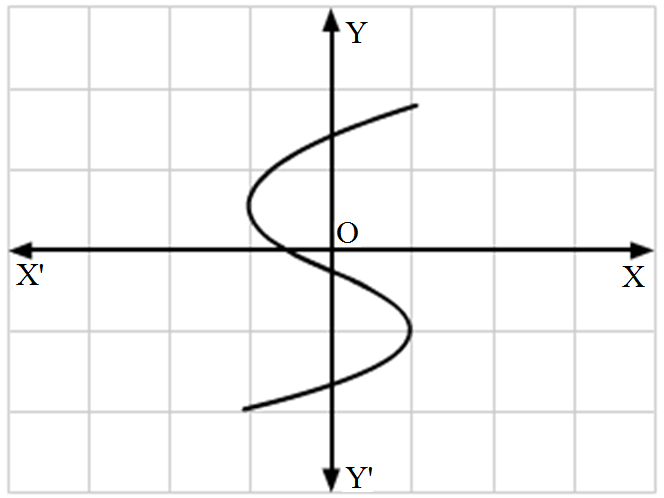
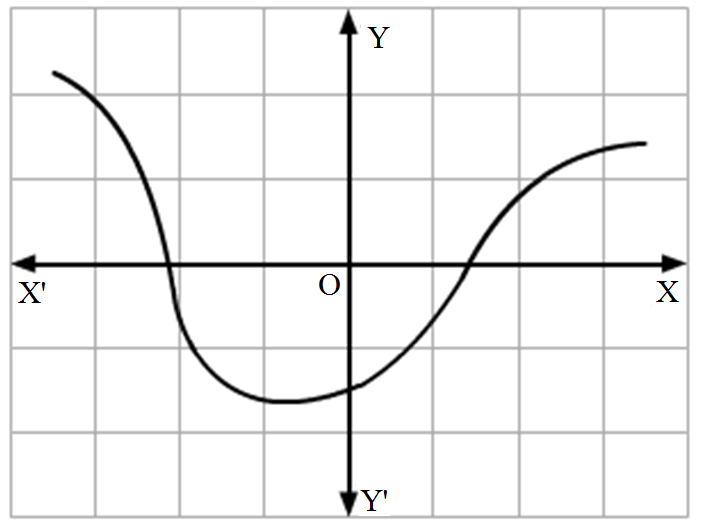
Which one of the following graphs represents a function?

  1.  

  1.  

If f : R → R is defined by f(x) = x2, find f-1(-25).