Question
Solve the following differential equations:$\frac{\text{dy}}{\text{dx}}=\text{y}\tan2\text{x, y}(0)=2$

Answer

We have,
$\frac{\text{dy}}{\text{dx}}=\text{y}\tan2\text{x, y}(0)=2$
$\Rightarrow\frac{1}{\text{y}}\text{dy}=\tan2\text{x dx}$
Integrating both sides, we get
$\int\frac{1}{\text{y}}\text{dy}=\int\tan2\text{x dx}$
$\Rightarrow\log|\text{y}|=\frac{1}{2}\log|\sec2\text{x}|+\frac{1}{2}\log\text{C}$
$\Rightarrow\text{y}^2=\text{C}\sec2\text{x}\dots(1)$
It is given that at $\text{x}=0,\text{y}=2.$
$\therefore\text{C}=4$
Substituting the value of C in (1), we get
$\therefore\text{y}^2=\frac{4}{\cos2\text{x}}$
$\Rightarrow\text{y}=\frac{2}{\sqrt{\cos2\text{x}}}$
Hence, $\text{y}=\frac{2}{\sqrt{\cos2\text{x}}}$ is the required solution.

Need a full question paper?

Generate a complete, print-ready paper with questions like this in minutes — across 16+ boards, with answer keys.

Start Generating Free

Similar questions

Find the vector equation of a line passing through the point with position vector $\hat{\text{i}}-2\hat{\text{j}}-3\hat{\text{k}}$ and parallel to the line joining the points with position vectors $\hat{\text{i}}-\hat{\text{j}}+4\hat{\text{k}}$ and $2\hat{\text{i}}+\hat{\text{j}}+2\hat{\text{k}}.$ Also, find the cartesian equivalent of this equation.
If $A = \left[ {\begin{array}{*{20}{c}} 2&{ - 1}&1 \\ { - 1}&2&{ - 1} \\ 1&{ - 1}&2 \end{array}} \right]$, verify that $A^3 - 6A^2 + 9A - 4I = 0$ and hence find $A^{-1}$
A dietician wishes to mix together two kinds of food X and Y in such a way that the mixture contains at least 10 units of vitamin A, 12 units of vitamin B and 8 units of vitamin C. The vitamin contents of one kg food is given below:
Food Vitamin A Vitamin B Vitamin C
X 1 2 3
Y 2 2 1
One kg of food X costs Rs. 16 and one kg of food Y costs Rs. 20. Find the least cost of the mixture which will produce the required diet?
Evaluate:
$\int\limits^{\pi/2}_{0} \frac{2^{\sin\text{x}}}{2^{\sin\text{x}} + 2^{\cos \text{x}}}\text{dx}$
For any a, b, x, y > 0, prove that:
$\frac{2}{3}\tan^{-1}\Big(\frac{3\text{a}\text{b}^2-\text{a}^3}{\text{b}^3-3\text{a}^2\text{b}}\Big)+\frac{2}{3}\tan^{-1}\Big(\frac{3\text{x}\text{y}^2-\text{x}^3}{\text{y}^3-3\text{x}^2\text{y}}\Big)=\tan^{-1}\frac{2\alpha\beta}{\alpha^2-\beta^2}$
where $\alpha=-\text{ax}+\text{by},\beta=\text{bx}+\text{ay}$
For the matrix $\text{A}=\begin{bmatrix}1&1&1\\1&2&-3\\2&-1&3\end{bmatrix}$Show that $A^3 - 6A^2 + 5A + 11I = 0$. Hence, find $A^{-1}.$
Solve the following differential equation:
$\frac{\text{dy}}{\text{dx}}+2\text{y}=\sin\text{x}$
Find the vector equation of the line through the origin which is perpendicular to the plane $\vec{\text{r}}\cdot(\hat{\text{i}}+2\hat{\text{j}}+3\hat{\text{k}})=3$
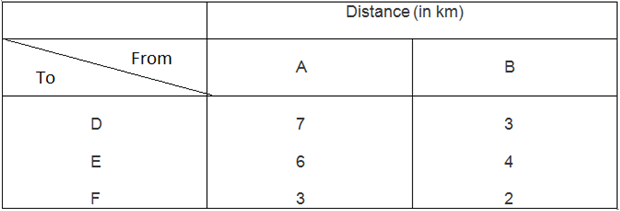
An oil company has two depots, $A$ and $B$, with capacities of $7000$ litres and $4000$  litres respectively. The company is to supply oil to three petrol pumps, $D, E, F$ whose requirements are $4500, 3000$ and $3500$ litres respectively. The distance (in km) between the depots and petrol pumps is given in the following table:

Assuming that the transportation cost per km is Rs. $1.00$ per litre, how should the delivery be scheduled in order that the transportation cost is minimum?
Find all vectors of magnitude $10\sqrt{3}$ that are perpendicular to the plane of $\hat{\text{i}}+2\hat{\text{j}}+\hat{\text{k}}$ and $-\hat{\text{i}}+3\hat{\text{i}}+4\hat{\text{k}}.$