Question
Solve the following equation: $4x^2 - 13x - 12 = 0$

Answer

$4 x^2-13 x-12=0$
$x^2-\frac{13}{4} x-3=0$
$x^2-4 x+\frac{3}{4} x-3=0$
$ x(x-4)+\frac{3}{4}(x-4)=0$
$(x-4)\left(x+\frac{3}{4}\right)=0$
$ (x-4)=0,\left(x+\frac{3}{4}\right)=0$
$x=4, x=-\frac{3}{4}$

Need a full question paper?

Generate a complete, print-ready paper with questions like this in minutes — across 16+ boards, with answer keys.
Start Generating Free

Similar questions

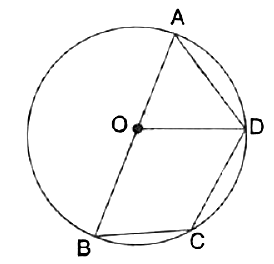
AB is the diameter of the circle with centre O. OD is parallel to BC and ∠ AOD = 60° ; calculate the numerical values of: ∠ DBC
Offices in Delhi are open for five days in a week (Monday to Friday). Two employees of an office remain absent for one day in the same particular week. Find the probability that they remain absent on:  the same day
A footpath of uniform width runs round the inside of a rectangular field $32\ m$ long and $24\ m$ wide. If the path occupies $208\ m^2,$ find the width of the footpath.
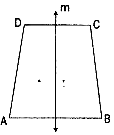
A quadrilateral ABCD has exactly one axis of symmetry, which is not a diagonal. Show that the quadrilateral is an isosoeles trapezium.
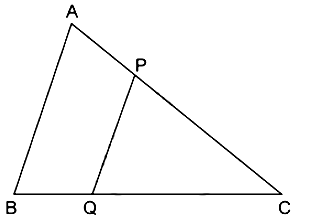
In the given figure, $PQ ‖ AB; CQ = 4.8\ cm\ QB = 3.6\ cm$ and $AB = 6.3 cm.$ Find :

If $AP = x,$ then the value of $AC$ in terms of $x.$
A shopkeeper buys a number of books for $Rs.840.$ If he had bought $5$ more books for the same amount, each book would have cost $Rs.4$ less. How many books did he buy?
₹ $ 8,000$ and ₹ $ 10,000$ were invested in ₹ $ 100$ shares giving dividends $12 \%$ and $8 \%$ respectively. The dividends are collected and all the shares are sold at a loss $2 \%$ and $3 \%$ respectively on the investment. Find (i) the dividend collected (ii) the total sale proceeds (iii) gain $\%$ on the whole transaction.
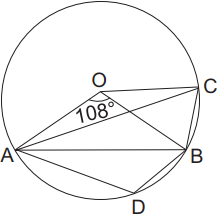
In the figure, A, D, B, C are four points on the circumference of a circle with centre O . arc $\mathrm{AB}=2$ arc BC and $\angle \mathrm{AOB}=108^{\circ}$. Calculate in degrees
(a) $\angle \mathrm{ACB}$
(b) $\angle \mathrm{CAB}$
(c) $\angle \mathrm{ADB}$.
Image
A man tosses two different coins (one of Rs 2 and another of Rs 5) simultaneously. What is the probability that he gets:   at most one head?