Question
Solve the following equation and verify the answer:
$\frac{3}{4}(\text{x}-1)=\text{x}-3$

Answer

$\frac{3}{4}(\text{x}-1)=\text{x}-3$ $\Rightarrow\frac{3}{4}(\text{x}-1)\times4=(\text{x}-3)\times4$ (Multiplying both sides by 4) ⇒ 3(x - 1) = 4(x - 3) ⇒ 3x - 3 = 4x - 12 (Removing brackets) ⇒ 3x - 4x = -12 + 3 (Transposing 4x to L.H.S. and -3 to R.H.S.) ⇒ -x = -9 ⇒ x = 9 So, x = 9 is a solution of the given equation. Check: Substituting x = 9 in the given equation, we get $\text{L.H.S}=\frac{3}{4}(9-1)=\frac{3}{4}\times8=6$$\text{R.H.S.}= 9 - 3 = 6$
$\therefore$ When x = 9, we have L.H.S. = R.H.S.

Need a full question paper?

Generate a complete, print-ready paper with questions like this in minutes — across 16+ boards, with answer keys.
Start Generating Free

Similar questions

Show that each of the following is meaningless. Give reason in each case.
  1. VC
  2. IL
  3. VVII
  4. IXX
Simplify:
$4\frac{4}{5}\div\Big\{2\frac{1}{5}-\frac{1}{2}\Big(1\frac{1}{4}-\overline{\frac{1}{4}-\frac{1}{5}}\Big)\Big\}$
Observe various commonly seen objects such as tree leaves, birds in flight, pictures of historical buildings, etc. Find symmetrical shapes among them and make a collection of them.
Solve the following equation and verify the answer:
$\frac{\text{2x}}{5}-\frac{3}{2}=\frac{\text{x}}{2}+1$
Solve the following equation and verify the answer:$\frac{\text{n}}{4}-5=\frac{\text{n}}{6}+\frac{1}{2}$
Kusumtai bought 80 cookers at Rs 700 each. Transport cost her Rs 1280. If she wants a profit of Rs 18000, what should be the selling price per cooker?
A Maths Riddle! (Textbook pg. no. 50)
We have four papers. On each of them there is a number on one side and some information on the other. The numbers on the papers are 7, 2, 15, 5. The information on the papers is given below in random order.
i. A number divisible by 7
ii. A prime number
iii. An odd number
iv. A number greater than 100
If the number on every paper is mismatched with the information on its other side, what is the number on the paper which says ‘A number greater than 100?
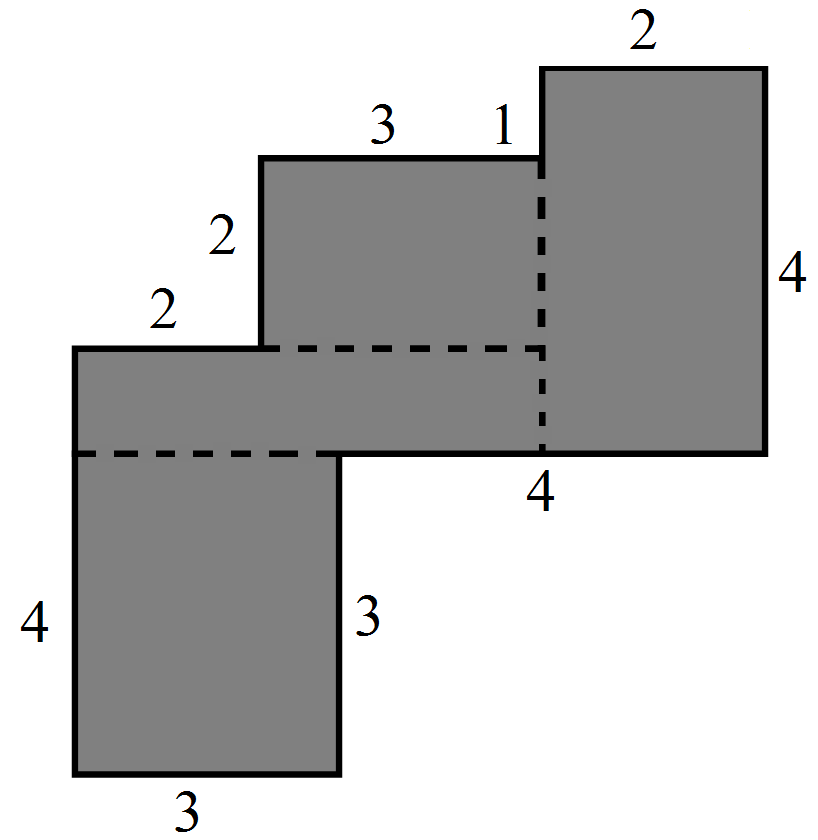
Calculate the area one of the shaded region given below (all measures are in cm):
Convert the common fractions into decimal fractions:

i. $\frac{3}{4}$

ii. $\frac{4}{5}$

iii. $\frac{9}{8}$

iv. $\frac{17}{20}$

Draw a line segment of length 8.6cm. Bisect it and measure the length of each part.