Question
Solve the following equation and verify the answer: $\frac{\text{x-3}}{5}=-2=\frac{\text{2x}}{5}$

Answer

$\frac{\text{x-3}}{5}=-2=\frac{\text{2x}}{5}$ multiplying each term by $5$,
we get $\frac{(\text{x}-3)\times5}{5}-(2\times5)=\frac{\text{2x}}{5}\times5$
$\Rightarrow x - 3 - 10 = 2x $
$\Rightarrow x - 13 = 2x $
$\Rightarrow x - 2x = 13$ (Transposing $2x$ to $L.H.S$. and $-13$ to $R.H.S.) $
$\Rightarrow -x = 13 $
$\Rightarrow x = -13$ (Multiplying both sides by -1)
So, $x = -13$ is a solution of the given equation.
Check: Substituting $x = -13$ in the given equation,
we get $\text{L.H.S.}=\frac{-13-3}{5}-2=\frac{-16}{5}-2$$=\frac{-16-10}{5}=\frac{-26}{5}$
$\text{R.H.S.}=\frac{2\times(-13)}{5}=\frac{-26}{5}$
$\therefore$ When $x = -13,$
we have $L.H.S. = R.H.S.$

Need a full question paper?

Generate a complete, print-ready paper with questions like this in minutes — across 16+ boards, with answer keys.

Start Generating Free

Similar questions

Solve the following equation and verify the answer: $3(x + 2) - 2(x - 1) = 7$
Fill in the missing fraction: $\square-\frac{3}{6}=\frac{3}{6}$
Construct $\overline {AB}$ of length $7.8\ cm.$ From this cut off $\overline {AC}$ of length $4.7\ cm.$ Measure $\overline {BC}$.
Reduce the fraction to simplest from: $\frac{84}{98}$
Write the first four products of two numbers with difference 4 starting from in the following order: 
1, 2, 3, 4, 5, 6, ........
Identify the pattern in the products and write the next three products.
Write the natural numbers from $2$ to $12.$ What fraction of them are prime numbers$ ?$
Take three non-collinear points $A, B$ and $C$ on a page of your notebook. Join $AB, BC$ and $CA.$ What figure do you get$?$ Name the triangle. Also, name:
$i.\ $The side opposite to $\angle\text{B.}$
$ii.\ $The angle opposite to side $AB.$
$iii.\ $The vertex opposite to site $BC.$
$iv.\ $The side opposite to vertex $B.$
Match the following:
S.No.
Shape
S.No.
Number of lines of symmetry
$i.$
Isosceles triangle.
$a.$
$6$
$ii.$
Square.
$b.$
$5$
$iii.$
Kite.
$c.$
$4$
$iv.$
Equilateral triangle.
$d.$
$3$
$v.$
Rectangle.
$e.$
$2$
$vi.$
Regular hexagon.
$f.$
$1$
$vii.$
Scalene triangle.
$g.$
$0$
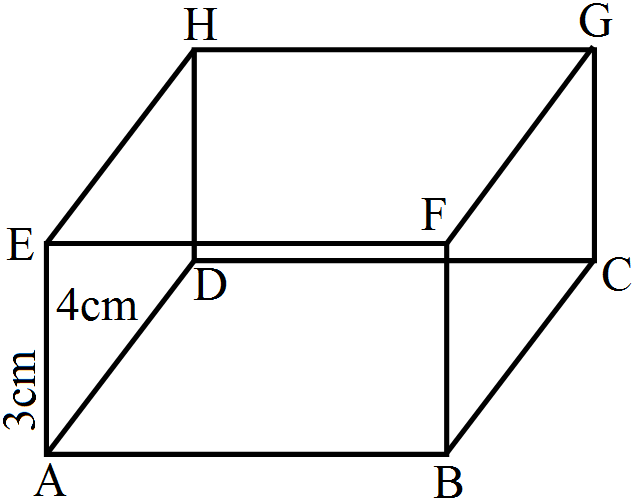
The dimensions of a cuboid with vertices $\text{A, B, C, D, E, F, G}$ and $H$ are as shown:

$i.\ $Which edges are of length $4\ cm?$ Which edges are of length $5\ cm?$
$ii.\ $Which faces have area equal to $20\ cm^2$?
$iii.\ $Which faces have the largest area$?$ What is this largest area$?$
$iv.\ $Which faces have a diagonal equal to $5\ cm?$
$v.\ $What is the area of the base of this cuboid$?$
$vi.\ $Do all the lateral faces have the same area$?$
Mark the correct alternative in the following: If six men can do a piece of work in $6$ days, then $3$ men can do same work in,