Question
Solve the following equation and verify your answer: $\Big(\frac{\text{x}+1}{\text{x}+2}\Big)^2=\frac{\text{x}+2}{\text{x}+4}$

Answer

$\Big(\frac{\text{x}+1}{\text{x}+2}\Big)^2=\frac{\text{x}+2}{\text{x}+4}$
$\Rightarrow\frac{(\text{x}+1)^2}{(\text{x}+2)^2}$
$=\frac{(\text{x}+1)}{(\text{x}+4)}$
By cross multiplication,
$=(\text{x}+1)^2\times(\text{x}+4)=(\text{x}+2)^2(\text{x}+2)$
$=(\text{x}^2+2\text{x}+1)(\text{x}+4)=(\text{x}^2+4\text{x}+4)(\text{x}+2)$
$\Rightarrow\text{x}^3+4\text{x}^2+2\text{x}^2+8\text{x}+\text{x}+ 4$
$=\text{x}^3+2\text{x}^2+4\text{x}^2+8\text{x}+4\text{x}+8$
$\Rightarrow\text{x}^3+6\text{x}^2+9\text{x}+4=\text{x}^3+6\text{x}^2+12\text{x}+8$
$\Rightarrow\text{x}^3+6\text{x}^2+9\text{x}-\text{x}^3-6\text{x}^2-12\text{x}=8-4$ (By transposition)
$\Rightarrow-3\text{x}$
$=4$
$\Rightarrow\text{x}=\frac{4}{-3}$
$\therefore\text{x}=\frac{-4}{3}$
Verification: $\text{L.H.S}=\bigg(\frac{\text{x}+1}{\text{x}+2}\bigg)^2=\Bigg(\frac{\frac{-4}{3}+1}{\frac{-4}{3}+2}\Bigg)$
$=\Bigg(\frac{\frac{-4+3}{3}}{\frac{-4+6}{3}}\Bigg)^2=\Bigg(\frac{\frac{-1}{3}}{\frac{2}{3}}\Bigg)^2$
$=\bigg(\frac{\frac{-1}{3}}{3}\times\frac{3}{2}\bigg)^2=\bigg(\frac{-1}{2}\bigg)^2=\frac{1}{4}$
$\text{R.H.S}=\frac{\text{x}+2}{\text{x}+4}=\frac{\frac{-4}{3}+2}{\frac{-4}{3}+2}=\frac{\frac{-4+6}{3}}{\frac{-4+12}{3}}$
$=\frac{\frac{2}{3}}{\frac{8}{3}}=\frac{2}{3}\times\frac{3}{8}=\frac{1}{4}$
$\therefore\text{L.H.S}=\text{R.H.S}$

Need a full question paper?

Generate a complete, print-ready paper with questions like this in minutes — across 16+ boards, with answer keys.
Start Generating Free

Similar questions

A metal cube of edge $12\ cm$ is melted and formed into three smaller cubes. If the edges of the two smaller cubes are $6\ cm$ and $8\ cm$, find the edge of the third smaller cube.
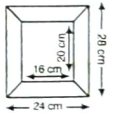
Diagram of the adjacent picture frame has outer dimensions $24 cm \times 28 cm$ and inner dimensions $16 cm \times 20 cm$. Find the area of each section of the frame, if the width of each section is same.
Image
Complete the table.
First expressionSecond expressionProduct
(i)$a$$b+c+d$
(ii)$x+y-5$$5xy$
(iii)$p$$6 p^2-7 p+5$
(iv)$4 p^2 q^{2}$$p^2-q^2$
(v)$a+b+c$$abc$
Find the value of $\left(5 x^6\right) \times\left(-1.5 x^2 y^3\right) \times\left(-12 x y^2\right)$ when $x=1, y=0.5$.
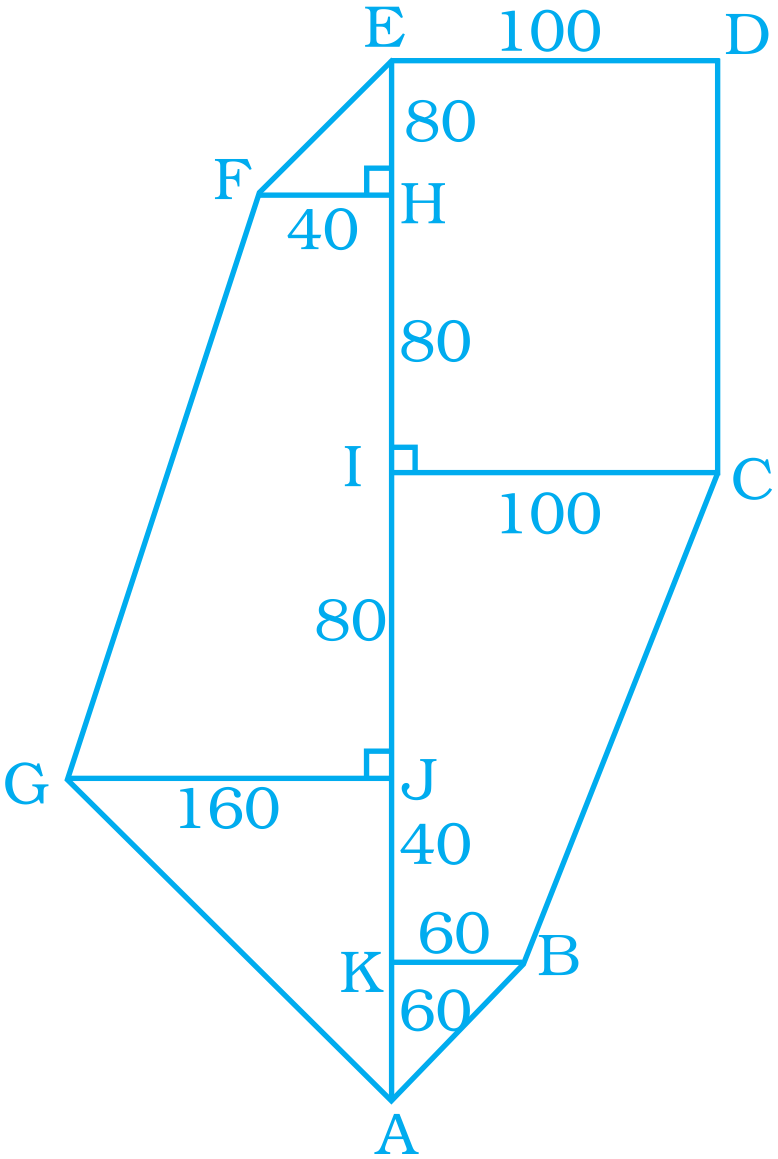
Find the area of the following fields. All dimensions are in metres.
Construct a frequency table with equal class intervals from the following data on the monthly wages (in rupees) of $28$ labourers working in a factory, taking one of the class intervals as $210-230 (230$ not included$): 220, 268, 258, 242, 210, 268, 272, 242, 311, 290, 300, 320, 319, 304, 302, 318, 306, 292, 254, 278, 210, 240, 280, 316, 306, 215, 256, 236.$
Find 3 examples where the product of two numbers remains unchanged when one of them is increased by 2 and the other is decreased by 4.
Solve the following equation and also check your result in case: $(3\text{x}-8)(3\text{x+2})-(4\text{x}-11)(2\text{x}+1)=(\text{x}-3)(\text{x}+7)$
Simplify: $(5x - 3)(x + 2) - (2x + 5)(4x - 3)$
A shopkeeper allows $20\%$ off on the marked price of goods and still gets a profit of $25\%$. What is the actual cost to him of an artical marked $Rs 500$ ?