Question
Solve the following equation and verify your answer:
$\frac{3\text{x}+5}{2\text{x}+7}=4$

Answer

$\frac{3\text{x}+5}{2\text{x}+7}=\frac{4}{1}$By cross multiplication:
$4(2\text{x}+7)=1\times(3\text{x}+5)$ $8\text{x}+28=3\text{x}+5$ $8\text{x}-3\text{x}=5-28$ (By transposition) $\Rightarrow5\text{x}=-23$ $\Rightarrow\text{x}=\frac{-23}{5}$ $\text{x}=\frac{-23}{5}$Verification:
$\text{L.H.S.}=\frac{3\text{x}+5}{2\text{x}+7}=\frac{3\Big(\frac{-23}{5}\Big)+5}{2\Big(\frac{-23}{5}\Big)+7}$ $=\frac{\frac{-69}{5}+5}{\frac{-46}{5}+7}=\frac{\frac{-69+25}{5}}{\frac{-46+35}{5}}=\frac{\frac{-44}{5}}{\frac{-11}{5}}$ $\frac{-44}{5}\times\frac{-5}{11}=4=\text{R.H.S.}$

Need a full question paper?

Generate a complete, print-ready paper with questions like this in minutes — across 16+ boards, with answer keys.

Start Generating Free

Similar questions

S.No.

Number

Power of the root

Root of the power

1.

(225)^((3)/(2))

" Cube of square root of 225

" Square root of cube of 225"

2.

(45)^((4)/(5))

3.

(81)^((6)/(7))

4.

(100)^((4)/(10))

5.

(21)^((3)/(7))

Find the following product and verify the result for x = -1, y = -2:
$\big(\frac{1}{3}\text{x}−\frac{\text{y}^2}{5}\big)\big(\frac{1}{3}\text{x}+\frac{\text{y}^2}{5}\big)$
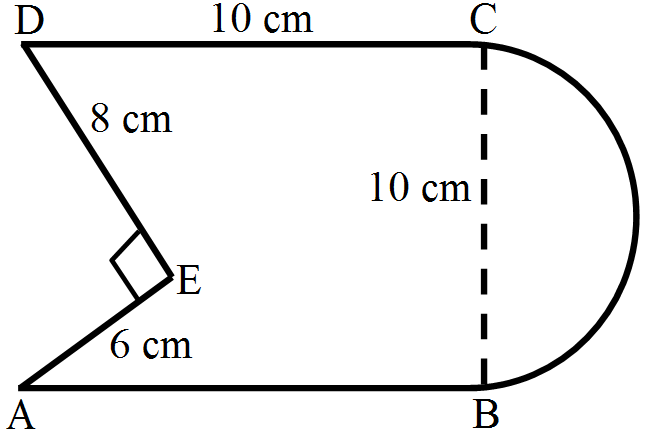
Find the area of Fig. in square cm, correct to one place of decimal. $\Big(\text {Take }\pi=\frac{22}{7}\Big)$

The following line graph shows the change in temperature of a block of ice when heated.
Study the above graph carefully and answer the questions given below:
  1. For how many seconds did the ice block have no change in temperature?
  2. For how long was there a change in temperature?
  3. After how many seconds of heating did the temperature become constant at 100°C?
  4. What was the temperature after 25 seconds?
  5. What will be the temperature after 1.5 minutes? Justify your answer.
If $\text{x}+\frac{1}{\text{x}}=12,$ find the value of $\text{x}−\frac{1}{\text{x}}.$
Which of the following numbers are squares of even numbers?
121, 225, 256, 324, 1296, 6561, 5476, 4489, 373758
Construct a quadrilateral BDEF, where DE = 4.5cm, EF = 3.5cm, FB = 6.5cm, $\angle\text{F}=50^\circ$ and $\angle\text{E}=100^\circ.$
x varies inversely as y, when x = 15 then y = 10, if x = 20, then y = ?
In ∆ABCD, l(AB) = 6.4 cm, l(BC) = 4.8 cm, m∠A = 70°, m∠B = 50°, m∠C = 140°.
Making use of the cube root table, find the cube root 8.65