Question
Solve the following equation by using formula :
$25x^2 + 30x + 7 = 0$

Answer

$\begin{aligned} & 25 x^2+30 x+7=0 \\ & \text { Here } a=25, b=30, c=7 \\ & D=b^2-4 a c \\ & =(30)^2-4 \times 25 \times 7 \\ & =900-700 \\ & =200 \\ & \because x=\frac{-b \pm \sqrt{D}}{2 a} \\ & =\frac{-30 \pm \sqrt{200}}{2 \times 25} \\ & =\frac{-30 \pm \sqrt{100 \times 2}}{50} \\ & =\frac{-30 \pm 10 \sqrt{2}}{50} \\ & =\frac{-3 \pm \sqrt{2}}{5} \\ & \therefore x_1=\frac{-3+\sqrt{2}}{5} \text { and } x_2=\frac{-3-\sqrt{2}}{5}\end{aligned}$
Hence $x=\frac{-3+\sqrt{2}}{5}, \frac{-3-\sqrt{2}}{5}$.

Need a full question paper?

Generate a complete, print-ready paper with questions like this in minutes — across 16+ boards, with answer keys.
Start Generating Free

Similar questions

Use the real number line to find the range of values of x for which:-1 < x ≤ 6 and -2 ≤ x ≤ 3
If $A=\left[\begin{array}{ll}a & 0 \\ 0 & 2\end{array}\right], B =\left[\begin{array}{cc}0 & -b \\ 1 & 0\end{array}\right], M=\left[\begin{array}{cc}1 & -1 \\ 1 & 1\end{array}\right]$ and $B A=M^2$ find the values of $a$ and $b$.
Point A (2, -4) is reflected in origin as A’. Point B (- 3, 2) is reflected on X-axis as B’.
(i) Write the co-ordinates of A’.
(ii) Write the co-ordinates of B’.
(iii) Calculate the distance A’B’.
Give your answer correct to 1 decimal place, (do not consult tables).
The mean of 1, 7, 5, 3, 4 and 4 is m. The numbers 3, 2, 4, 2, 3, 3 and p have mean m-1 and median q. Find p and q.
The diameter and a chord of a circle have a common end-point. If the length of the diameter is 20 cm and the length of the chord is 12 cm, how far is the chord from the centre of the circle?
If the third term of an A.P. is 1 and 6th term is – 11, find the sum of its first 32 terms.
Find the value of the unknown in the following proportion :
c
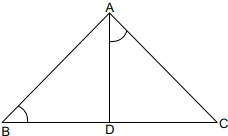
In $\triangle \mathrm{ABC}, \angle \mathrm{ABC}=\angle \mathrm{DAC}, \mathrm{AB}=8 \mathrm{~cm}$. $\mathrm{AC}=4 \mathrm{~cm}$ and $\mathrm{AD}=5 \mathrm{~cm}$
(a) Prove that $\triangle \mathrm{ACD} \sim \triangle \mathrm{BCA}$
(b) Find BC and CD
(c) Find $\operatorname{ar}(\triangle \mathrm{ACD})$ : $\operatorname{ar}(\triangle \mathrm{ABC})$
Image
How many spherical bullets can be made out of a solid cube of lead whose edge measures $44\ cm,$ each bullet being $4\ cm$ in diameter?
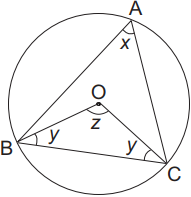
BC is a chord of a circle with centre $\mathrm{O} . \mathrm{A}$ is a point on major arc BC as shown in the figure. Prove that $\angle \mathrm{BAC}+\angle \mathrm{OBC}=90^{\circ}$.
Image