Question
Solve the following equation for x:
$\tan^{-1}\Big(\frac{\text{x}-2}{\text{x}-4}\Big)+\tan^{-1}\Big(\frac{\text{x}+2}{\text{x}+4}\Big)=\frac{\pi}{4}$
Answer

$\tan^{-1}\Big(\frac{\text{x}-2}{\text{x}-4}\Big)+\tan^{-1}\Big(\frac{\text{x}+2}{\text{x}+4}\Big)=\frac{\pi}{4}$
We know
$\because\ \tan^{-1}\text{x}+\tan^{-1}\text{y}=\tan^{-1}\Big(\frac{\text{x}+\text{y}}{1-\text{xy}}\Big)$
$\Rightarrow\tan^{-1}\Bigg(\frac{\frac{\text{x}-2}{\text{x}-4}+\frac{\text{x}+2}{\text{x}+4}}{1-\frac{\text{x}-2}{\text{x}-4}\times\frac{\text{x}+2}{\text{x}+4}}\Bigg)=\frac{\pi}4{}$
$\Rightarrow\tan^{-1}\Bigg(\frac{\frac{\text{x}^2+2\text{x}-8+\text{x}^2-2\text{x}-8}{(\text{x}-4)(\text{x}+4)}}{\frac{\text{x}^2-16-\text{x}^2+4}{(\text{x}-4)(\text{x}+4)}}\Bigg)=\frac{\pi}{4}$
$\Rightarrow\frac{2\text{x}^2-16}{-12}=\tan\frac{\pi}{4}$
$\Rightarrow\frac{2\text{x}^2-16}{-12}=1$
$\Rightarrow2\text{x}^2-16=-12$
$\Rightarrow2\text{x}^2=4$
$\Rightarrow\text{x}^2=2$
$\Rightarrow\text{x}=\pm\sqrt2$

Need a full question paper?

Generate a complete, print-ready paper with questions like this in minutes — across 16+ boards, with answer keys.

Start Generating Free

Similar questions

Let $\text{A}=\begin{bmatrix}1&2\\-1&3\end{bmatrix},\ \text{B}=\begin{bmatrix}4&0\\1&5\end{bmatrix},$ $\text{C}=\begin{bmatrix}2&0\\1&-2\end{bmatrix},$ a = 4, b = -2, then show that $\text{A}(\text{BC})=(\text{AB})\text{C}.$
Give examples of two one-one functions $f_1$ and $f_2$ from $R$ to $R,$ such that $f_1 + f_2 : R \rightarrow R.$ defined by $(f_1 + f_2)(x) = f_1(x) + f_2(x)$ is not one-one.
If a matrix has 8 elements, what are the possible orders it can have? What if it has 5 elements?
Check the commutativity and associativity of the following binary operations:
'o' on Q defined by $\text{a o b}=\frac{\text{ab}}{2}$ for all a, b ∈ Q.
Find the points o local maxima or local minima, if any, of the following functions, using the first derivatives test. Also, find the local maximum or local minimum values, as the case may be:
$\text{f}'(\text{x})=\frac{\text{x}}{2}+\frac{2}{\text{x}}, \text{x}\geq0$
A problem in mathematics is given to three students whose chances of solving it correctly are $1/2, 1/3$ and $1/4$ respectively. What is the probability that only one of them solves it correctly?
Evaluate the following integrals:
$\int\sqrt{16\text{x}^2+25}\text{dx}$
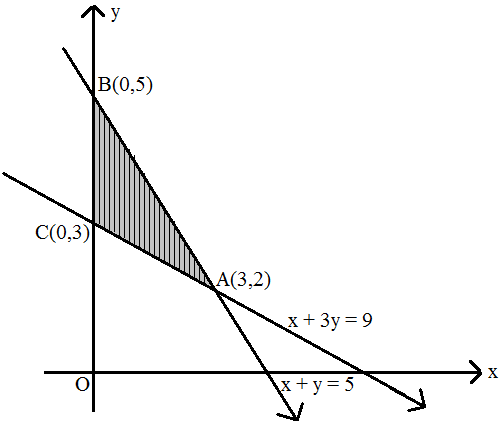
The feasible region for a LPP is shown in. Find the minimum value of Z = 11x + 7y.
Find x, if $\begin{bmatrix}x&-5&-1\end{bmatrix}\begin{bmatrix}1&0&2\\0&2&1\\2&0&3\end{bmatrix}\begin{bmatrix}x\\4\\1\end{bmatrix} = 0.$
Examine the consistency of the system of equations:
3x - y - 2z = 2
2y - z = -1
3x - 5y = 3