Question
Solve the following equations:
$\cos\text{x}+\sin\text{x}=\cos2\text{x}+\sin2\text{x}$

Answer

$\cos\text{x}+\sin\text{x}=\cos2\text{x}+\sin2\text{x}$$\Rightarrow\cos2\text{x}-\cos\text{x}+\sin2\text{x}-\sin\text{x}=0$
$\Rightarrow-2\sin\frac{3\text{x}}{2}\sin\frac{x}{2}+2\cos\frac{3\text{x}}{2}\sin\frac{\text{x}}{2}=0$
$\Rightarrow2\sin\frac{\pi}{\text{x}}\Big(\cos\frac{3\pi}{2}-\sin\frac{3\pi}{2}\Big)=0$
$\Rightarrow2\sin\frac{\text{x}}{2}=0$ or $\cos\frac{3\text{x}}{2}-\sin\frac{3\text{x}}{2}=0$
$\Rightarrow\sin\frac{\text{x}}{2}=0$ or $\cos\frac{3\text{x}}{2}=\sin\frac{3\text{x}}{2}$
$\Rightarrow\frac{\text{x}}{2}=\text{n}\pi$ or $\tan\frac{3\text{x}}{2}=1$
$\Rightarrow\text{x}=2\text{n}\pi$ or $\tan\frac{3\text{x}}{2}=\tan\frac{\pi}{4}$
$\Rightarrow​​\text{x}=\text{n}\pi$ or $\frac{3\pi}{2}-\text{n}\pi+\frac{\pi}{4}$
$\Rightarrow\text{x}=2\text{n}\pi$ or $3\text{x}=2\text{n}\pi+\frac{\pi}{2}$
$\Rightarrow\text{x}=2\text{n}\pi$ or $\text{x}=\frac{2\text{n}\pi}{3}+\frac{\pi}{6},\text{n}\in\text{Z}$

Need a full question paper?

Generate a complete, print-ready paper with questions like this in minutes — across 16+ boards, with answer keys.

Start Generating Free

Similar questions

Find the equation of an ellipse with its foci on y-axis, eccentricity $\frac{3}{4},$ centre at the origin and passing througth (6, 4).
Find the sum of the series whose $n^{th} $ term is:
$2n^3 + 3n^2 - 1$
Find the value of

$(\sqrt{3}+1)^4-(\sqrt{3}-1)^4$

Prove that:
$\cos\frac{\pi}{15}\cos\frac{2\pi}{15}\cos\frac{3\pi}{15}\cos\frac{4\pi}{15}\cos\frac{5\pi}{15}\cos\frac{6\pi}{15}\cos\frac{7\pi}{15}=\cos\frac{1}{128}$
Find the sum of the following series to $n$ terms:
$2^2 + 4^2 + 6^2 + 8^2 + ....$
If $a, b, c$ are in G.P., prove that:
$\frac{\text{a}^2+\text{ab}+\text{b}^2}{\text{bc}+\text{ca}+\text{ab}}=\frac{\text{b}+\text{a}}{\text{c}+\text{b}}$
Let P(n) be the statement: $2^{\text{n}}\geq3\text{n}.$ If p(r) is true, Show that p(r + 1) is true. Do you conclude that p(n) is true for all $\text{n}\in\text{N}$?
Solve the following for $x$, where $|x|$ is modulus function, $[x]$ is the greatest integer function, $\{x\}$ is a fractional part function.$\left|x^2-9\right|+\left|x^2-4\right|=5$
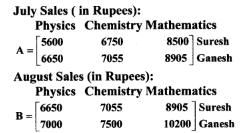
There are two book shops owned by Suresh and Ganesh. Their sales (in Rupees) for books in three subjects – Physics, Chemistry and Mathematics for two months, July and August 2017 are given by two matrices A and B.

Image

i. Find the increase in sales in Rupees from July to August 2017.

ii. If both book shops got 10% profit in the month of August 2017, find the profit for each bookseller in each subject in that month.

Find the conditions that the straight lines $y = m_1x + c_1, y = m_2x + c_2$ and $y = m_3x + c_3$ may meet in a point.