Question
Solve the following equations :
$\frac{2 x}{3}+1=\frac{7 x}{15}+3.$

Answer

We have, $\quad \frac{2 x}{3}+1=\frac{7 x}{15}+3$
$\Rightarrow \quad \frac{2 x}{3}-\frac{7 x}{15}=3-1\quad$ [transposing $\frac{7 x}{15}$ to LHS and 1 to RHS]
$\Rightarrow \quad \frac{10 x-7 x}{15}=2 \quad[\because$ LCM of 3 and 15 is 15$]$
$\Rightarrow \quad \frac{3 x}{15}=2$
$\Rightarrow \quad \frac{3 x}{15} \times 5=2 \times 5 \quad$ [multiplying both sides by 5]
$\Rightarrow \quad \frac{15 x}{15}=2 \times 5 \Rightarrow x=2 \times 5$
$\Rightarrow \quad x=10$, which is the required solution.
Check For $x=10$
LHS $=\frac{2(10)}{3}+1=\frac{23}{3}$
RHS $=\frac{7(10)}{15}+3=\frac{23}{3}$
$\therefore \quad$ LHS $=$ RHS $\quad$ [as required]

Need a full question paper?

Generate a complete, print-ready paper with questions like this in minutes — across 16+ boards, with answer keys.

Start Generating Free

Similar questions

The mass of an aluminium rod varies directly with its length. If a 16 cm long rod has a mass of 192 g , then find the length of the rod whose mass is 105 g .
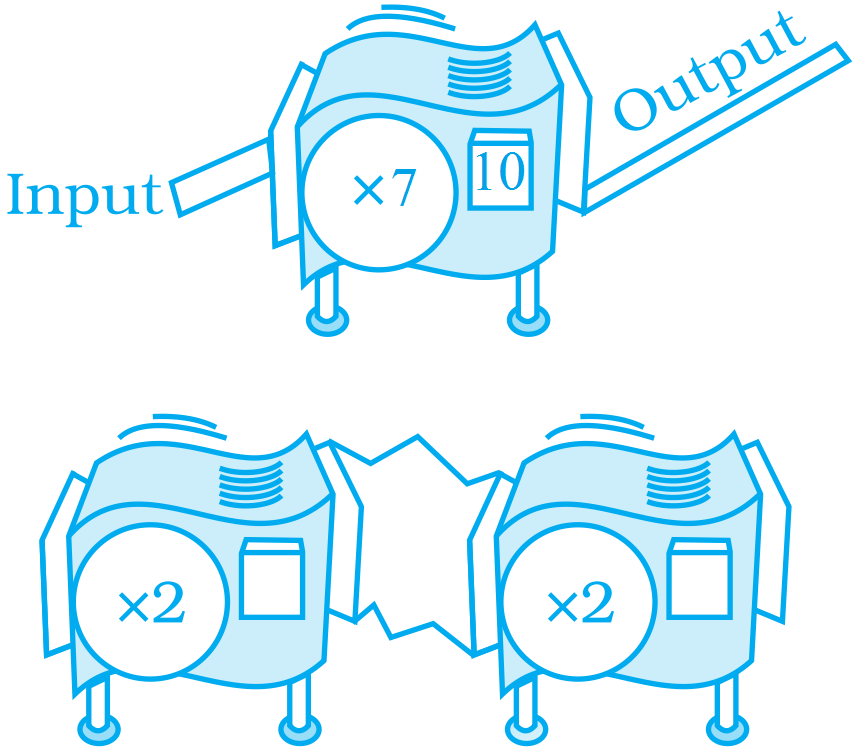
Two machines can be hooked together. When something is sent through this hook up, the output from the first machine becomes the input for the second.
$a.$ Which two machines hooked together do the same work a $(x102)$ machine does? Is there more than one arrangement of two machines that will work?

$b.$ Which stretching machine does the same work as two $(x2)$ machines hooked together?
Find the product: $\frac{4}{3}\text{a}\big(\text{a}^2 +\text{ b}^2 − 3\text{c}^2\big)$
The squares of which of the following would be odd numbers?
(i) 431 $\quad$ (ii) 2826 $\quad$ (iii) 7779 $\quad$ (iv) 82004
In $1975$, the consumption of water for human use was about $3850$ cu.km/year. It increased to about $6000$ cu.km/year in the year $2000$. Find the per cent increase in the consumption of water from $1975$ to $2000$. Also, find the annual per cent increase in consumption (assuming water consumption increases uniformly).
Simplify:
$2 a^2+3 a\left(1-2 a^3\right)+a(a+1)$
Find the $S.P.$ if$(i) M.P. = Rs. 1300$ and Discount $= 10\%$
Find the squares of the following numbers using diagonal method: $98$
Compute the amount and the compound interest in each of the following by using the formulae when:
Principal $= Rs. 3000,$ Rate $= 5\%,$ Time $= 2$ years
$ABCD$ is a rhombus. If $\angle\text{ACB}=40^\circ$, find $\angle\text{ADB}$.