Question
Solve the following initial value problems:
$\frac{\text{dy}}{\text{dx}}-\frac{\text{y}}{\text{x}}+\text{cosec}\frac{\text{y}}{\text{x}}=0,\text{y}(1)=0$
Answer

$\frac{\text{dy}}{\text{dx}}-\frac{\text{y}}{\text{x}}+\text{cosec}\frac{\text{y}}{\text{x}}=0,\text{y}(1)=0$
This is a homogeneous equation, Put y = vx
$\frac{\text{dy}}{\text{dx}}=\text{v + x}\frac{\text{dv}}{\text{dx}}$
$\text{v + x}\frac{\text{dv}}{\text{dx}}-\text{v + cosec v}=0$
$\text{x}\frac{\text{dv}}{\text{dx}}=\text{cosec v}$
$\frac{\text{dv}}{\text{cosec v}}=\frac{\text{dx}}{\text{x}}$
$\sin\text{v dv}=\frac{\text{dx}}{\text{x}}$
On integrating both sides, we get
$\int\sin\text{v dv}=\int\frac{\text{dx}}{\text{x}}$
$-\cos\text{v}=\log_{\text{e}}\text{x + C}$
$-\cos\text{v}+\log_{\text{e}}\text{x}=\text{C}$
$\cos\text{v}+\log_{\text{e}}\text{x}=-\text{C}$
$\cos\Big(\frac{\text{y}}{\text{x}}\Big)+\log_{\text{e}}\text{x}=-\text{C}$
As y(1) = 0
$\cos\Big(\frac{0}1\Big)=0+\log_{\text{e}}1=-\text{C}$
$1+0=-\text{C}$
$\Rightarrow\ \text{C}=-1$
$\Rightarrow\ \cos\Big(\frac{\text{y}}{\text{x}}\Big)+\log_{\text{e}}\text{x}=1$

Need a full question paper?

Generate a complete, print-ready paper with questions like this in minutes — across 16+ boards, with answer keys.

Start Generating Free

Similar questions

Find the equations of the tangent and the normal to the following curves at the indicated points.
$\text{x}=3\cos\theta-\cos^3\theta,\text{y}=3\sin\theta-\sin^3\theta$
$\overrightarrow{\text{n}}$ is a vector of magnitude $\sqrt{3}$ and is equally inclined to an acute angle with the coordinate axes. Find the vector and cartesian form of the equation of a plane which passes through (2, 1, -1) and is normal to $\overrightarrow{\text{n}}$
Solve the following differential equation:
$y^2dx + (x^2 – xy + y^2)dy = 0$
One kind of cake requires 300gm of flour and 15gm of fat, another kind of cake requires 150gm of flour and 30gm of fat. Find the maximum number of cakes which can be made from 7.5kg of flour and 600gm of fat, assuming that there is no shortage of the other ingradients used in making the cake. Make it as an LPP and solve it graphically.
Find the area lying above the x-axis and under the paraola $y^2 = 4x - x^2$.
Three schools A, B and C want to award their selected students for the values of Honesty, Regularity and Hard work. Each school decided to award a sum of $\text{₹ 2,500, ₹ 3,100, ₹ 5,100}$ per student for the respective values. The number of students to be awarded by the three schools is given below in the table:
School A B C
Values
Honesty 3 4 6
Regularity 4 5 2
Hard work 6 3 2
Find the total money given in awards by the three schools separately, using matrices. Apart from the above-given values, suggest one more value which should be considered for giving award.
If $\text{x}=\text{a}\Big(\frac{1+\text{t}^2}{1-\text{t}^2}\Big)\text{ and y}=\frac{2\text{t}}{1-\text{t}^2},$ find $\frac{\text{dy}}{\text{dx}}$
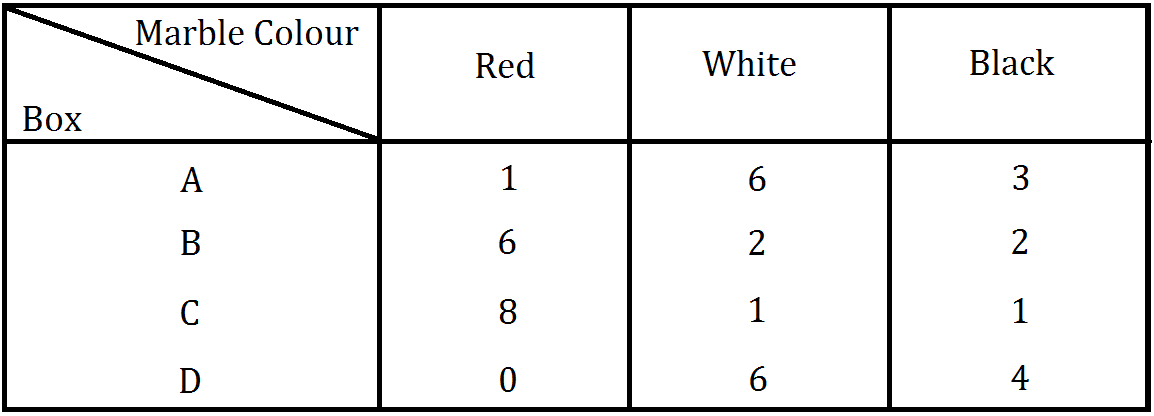
Suppose we have four boxes A, B, C, D containing coloured marbles as given below:
One of the boxes has been selected at random and a single marble is drawn from it. If the marble is red, what is the probability that it was drawn from,
  1. Box A?
  2. Box B?
  3. Box C?
Show that the function $\text{f(x)}\begin{cases}\text{x}^\text{m}\sin(\frac{1}{\text{x}}), &\text{x}\neq0 \\0 ,& \text{x}=0\end{cases}$
Neirher continuous but not diffierentiable, if $\text{m}\leq0$
Prove that the function $\text{f(x)}=\begin{cases}\frac{\sin\text{x}}{\text{x}},&\text{x}<0\\\text{x}+1,&\text{x}\geq0\end{cases}$ is everywhere continuous.