Question
Solve the following initial value problems:
$\frac{\text{dy}}{\text{dx}}+\text{y}\cot\text{x}=2\cos\text{x},\text{ y}\Big(\frac{\pi}{2}\Big)=0$
Answer

We have,
$\frac{\text{dy}}{\text{dx}}+\text{y}\cot\text{x}=2\cos\text{x},\text{ y}\Big(\frac{\pi}{2}\Big)=0$
$\frac{\text{dy}}{\text{dx}}+\text{y}\cot\text{x}=2\cos\text{x}\ ...(1)$
Clearly, it is a linear differential equation of the form
$\frac{\text{dy}}{\text{dx}}+\text{Py}=\text{Q}$
Where $\text{P}=\cot\text{x}$ and $\text{Q}=2\cos\text{x}$
$\therefore\text{ I.F.}=\text{e}^{\int\text{Pdx}}$
$=\text{e}^{\int\cot\text{x dx}}$
$=\text{e}^{\log\sin\text{x}}$
$=\sin\text{x}$
Multiplying both sides of (1) by $\text{I.F.}=\sin\text{x},$ we get
$\sin\text{x}\Big(\frac{\text{dy}}{\text{dx}}+\text{y}\cot\text{x}\Big)=2\sin\text{x }\cos\text{x}$
$\Rightarrow\sin\text{x}\frac{\text{dy}}{\text{dx}}+\text{y}\cos\text{x}=\sin2\text{x}$
Integrating both sides with respect to x, we get
$\text{y}\sin\text{x}=\int\sin2\text{x dx}+\text{C}$
$\Rightarrow\text{y}\sin\text{x}=-\frac{\cos2\text{x}}{2}+\text{C}\ ...(2)$
Now,
$\text{y}\Big(\frac{\pi}{2}\Big)=0$
$\therefore\ 0\times\sin\frac{\pi}{2}=-\frac{\cos\pi}{2}+\text{C}$
$\Rightarrow\text{C}=-\frac{1}{2}$
Putting the value of C in (2), we get
$\text{y}\sin\text{x}=-\frac{\cos2\text{x}}{2}-\frac{1}{2}$
$\Rightarrow2\text{y}\sin\text{x}=-(1+\cos2\text{x})$
$\Rightarrow2\text{y}\sin\text{x}=-2\cos^2\text{x}$
$\Rightarrow\text{y}=-\cot\text{x}\cos\text{x}$
Hence, $\text{y}=-\cot\text{x}\cos\text{x}$ is the required solution.

Need a full question paper?

Generate a complete, print-ready paper with questions like this in minutes — across 16+ boards, with answer keys.

Start Generating Free

Similar questions

Find the length of the perpendicular from $(2,-3,1)$ to the line $\frac{x+1}{2}=\frac{y-3}{3}=\frac{z+1}{-1}$
Evaluate the following integrals:$\int\text{e}^{\text{x}}.\frac{\sqrt{1-\text{x}^2}\sin^{-1}\text{x}+1}{\sqrt{1-\text{x}^2}}\text{dx}$
If $\text{A}=\begin{bmatrix}3&-5\\-4&2\end{bmatrix},$ then find $A^2 - 5A - 14I$. Hence, obtain $A^3$.
Find the coordinates of the foot of the perependicular drawn from the origin to the plane 2x - 3y + 4z - 6 = 0.
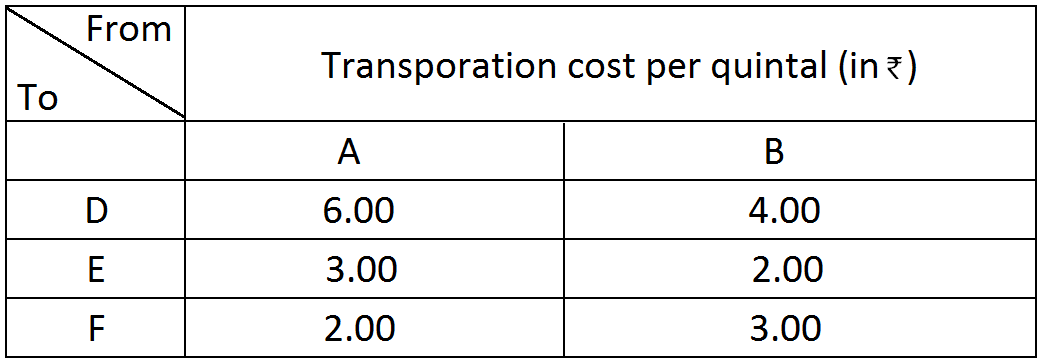
Tow godowns, $A$ and $B,$ have grain storage capacity of $100$ quintals and $50$ quintals respectively. They supply to $3$ ration shops, $D, E$ and $F$, whose requirements are $60, 50$ and $40$ quintals respectively. The cost of transportation per quintal from the godowns to the shops are given in the following table:


How should the supplies be transported in order that the transportation cost is minimum?
Find the area of the ragion bounded by $x^2 = 16y, y = 1, y = 4$ and the parabola y-axis and the first quadrant.
Solve the following determinant equations:
$\begin{vmatrix}1&\text{x}&\text{x}^2\\1&\text{a}&\text{a}^2\\1&\text{b}&\text{b}^2\end{vmatrix}=0,\text{a}\neq\text{b}$
If A and B are two events such that,
$\text{P(A)}=\frac{7}{13},\text{P(B)}=\frac{9}{13}$ and $\text{P}(\text{A}\cap\text{B})=\frac{4}{13},$ then find $\text{P}(\overline{\text{A}}|\text{B}).$
Solve the following initial value problems:
$\text{x}\frac{\text{dy}}{\text{dx}}-\text{y}=(\text{x}+1)\text{e}^{\text{x}},\text{ y}(1)=0$
Two sides of a parallelogram are $3 \hat{i}+4 \hat{j}-5 \hat{k}$ and $-2 \hat{j}+7 \hat{k}$. Find the unit vectors parallel to the diagonals.