Question
Solve the following linear programming problem by graphical method. Under the following constraints :
$
\begin{aligned}
x+2 y & \geq 10 \\
x+y & \geq 6 \\
3 x+y & \geq 8 \\
x, y & \geq 0
\end{aligned}
$
$\operatorname{minimise} Z=3 x+5 y$.
Answer


Image
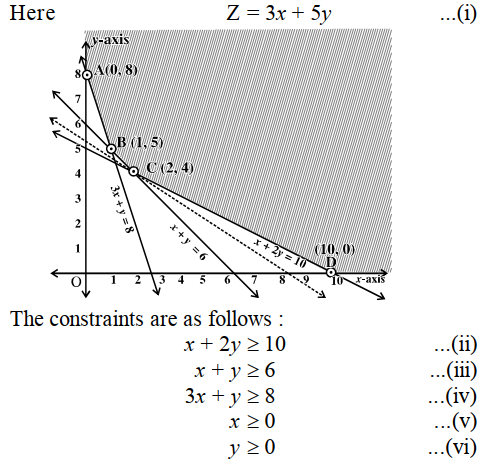
On drawing all the inequalities on the graph paper, ABCD is the feasible region of this problem where coordinates are as follows :
$A (0,8), B (1,5), C (2,4)$ and $D (10,0)$
Now we shall find the values of $Z$ at these points according to the following table :
Corner PointCorresponding Value of Z = 3x + 5y
A(0, 8)40
B (1, 5)28
C (2, 4)26 Minimum
D(10, 0)30

Hence the minimum value of Z at the corner point C (2, 4) = 26.

Need a full question paper?

Generate a complete, print-ready paper with questions like this in minutes — across 16+ boards, with answer keys.

Start Generating Free

Similar questions

A bag contains 3 red and 5 black balls and a second bag contains 6 red and 4 black balls. A ball is drawn from each bag. Find the probability that one is red and the other is black.
Evaluate the following definite integrals:
$\int_{1}^\limits{4}\frac{\text{x}^2+\text{x}}{\sqrt{2\text{x}+1}}\text{ dx}$
Find the foot of perpendicular from the point (2, 3, 4) to the line $\frac{4-\text{x}}{2}=\frac{\text{y}}{6}=\frac{1-\text{z}}{3}.$ Also, find the perpendicular distance from the given point to the line.
Solve the differential equation $\text{dy}=\cos\text{x}(2-\text{y}\text{cosesx})\text{dx}$ given that $\text{y}=2$ when $\text{x}=\frac{\pi}{2}.$
Find graphically, the maximum value of Z = 2x + 5y, subject to constraints given below:
$2\text{x}+4\text{y}\leq8$
$3\text{x}+\text{y}\leq6$
$\text{x}+\text{y}\leq4$
$\text{x}\geq0,\text{y}\geq0$
Solve the following differential equation:
$\text{2x}^{2}\frac{\text{dy}}{\text{dx}}-\text{2 xy + y}^{2}=0$
$\text{If A} = \begin{bmatrix}3&1\\-1&2\end{bmatrix},$ show that $A^2 - 5A + 7I = 0$. Hence find $A^{-1}.$
Evaluate the following integrals:$\int\sin^{-1}\sqrt{\text{x}}\text{dx}$
Find the position vector of a point R which divides the line joining two points P and Q whose position vectors are $(2\overrightarrow{\text{a}}+\overrightarrow{\text{b}})$ and$(\overrightarrow{\text{a}}-3\overrightarrow{\text{b}})$ respectively, externally in the ratio 1:2. Also, show that P is the mid point of the line segment RQ.
Divide $15$ into two parts such that the square of one multiplied with the cube of the other is minimum.