Question
Solve the following linear programming problem by graphical method.Under the constraints, maximise $Z=60 x+40 y$.
$
\begin{aligned}
x+2 y & \leq 12 \\
2 x+y & \leq 12 \\
x+\frac{5}{4} y & \geq 5 ; x \geq 0, y \geq 0
\end{aligned}
$
Answer

The given constraints are as follows :
$
\begin{aligned}
x+2 y & \leq 12\quad \quad \ldots \ldots(1) \\
2 x+y & \leq 12\quad \quad \ldots \ldots(2) \\
x+\frac{5}{4} y & \geq 5 \quad \quad \ldots \ldots(3)\\
x \geq 0, y & \geq 0\quad \quad \ldots \ldots(4)
\end{aligned}
$
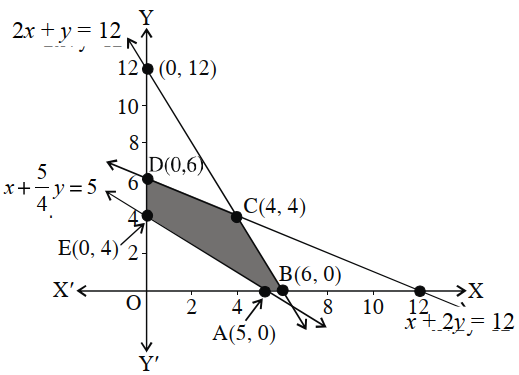
We draw the graph of the constraints (1) to (4). As shown with figure, the feasible region is ABCDE (shaded) which has been determined by the constraints (1) to (4). On observation we find that the feasible region is bounded.
Image
The coordinates of the corner points $A , B , C , D$ and E and respectively $(5,0),(6,0),(4,4),(0,6)$ and $(0,4)$.
Corner PointValue of Z = 60x + 40y
(5,0)300
(6,0)360
(4, 4)400 ← Maximum
(0,6)240
(0,4)1600

We see that at the point (4, 4), the value of Z is maximum.

Need a full question paper?

Generate a complete, print-ready paper with questions like this in minutes — across 16+ boards, with answer keys.

Start Generating Free

Similar questions

Find the shortest distance between the following pairs of lines whose vector equation are:
$\vec{\text{r}}=3\hat{\text{i}}+8\hat{\text{j}}+3\hat{\text{k}}+\lambda\big(3\hat{\text{i}}-\hat{\text{j}}+\hat{\text{k}}\big)$ and $\vec{\text{r}}=-3\hat{\text{i}}-7\hat{\text{j}}+6\hat{\text{k}}+\mu\big(-3\hat{\text{i}}+2\hat{\text{j}}+4\hat{\text{k}}\big)$
Evaluate the following intregals:
$\int\frac{1}{2+\sin\text{x}+\cos\text{x}}\text{dx}$
Find the area of region bounded by the triangle whose vertices are (-1, 1), (0, 5) and (3, 2), using integration.
The probability that a certain kind of component will survive a given shock test is $\frac{3}{4}.$ Find the probability that among 5 components tested.
  1. exactly 2 will survive.
  2. at most 3 will survive.
Find the coordinates of a point on the parabola $y = x^2+ 7x + 2$ which is closest to the strainght line $y = 3x -3.$
Solve the following differential equation
$(1+\text{x}^2)\text{dy}=\text{xy dx}$
Show that each of the given three vectors is a unit vector:$\frac{1}{7}(2\hat{i}+3\hat{j}+6\hat{k}),\ \frac{1}{7}(3\hat{i}-6\hat{j}+2\hat{k}),\ \frac{1}{7}(6\hat{ i}+2\hat{j}-3\hat{k})$
Also, show that they are mutually perpendicular to each other.
Maximum Z = 3x + 4y Subject to$\text{x}+\text{y}\leq30000$
$\text{y}\leq12000$
$\text{x}\geq6000$
$\text{x}\geq\text{y}$
$\text{x},\text{y}\geq0$
If $\text{A}=\begin{bmatrix}0&\text{c}&-\text{b}\\-\text{c}&0&\text{a}\\\text{b}&-\text{a}&0\end{bmatrix}$ and $\text{B}=\begin{bmatrix}\text{a}^2&\text{ab}&\text{ac}\\\text{ab}&\text{b}^2&\text{bc}\\\text{ac}&\text{bc}&\text{c}^2\end{bmatrix},$ show that $AB = BA = O_{3 \times 3}$
Evaluate the following intregals:
$\int\frac{\text{x}}{(\text{x}^2+1)(\text{x}-1)}\ \text{dx}$