Question
Solve the following linear programming problem by graphical method.Under the constraints, maximise $Z=60 x+40 y$.
$
\begin{aligned}
x+2 y & \leq 12 \\
2 x+y & \leq 12 \\
x+\frac{5}{4} y & \geq 5 ; x \geq 0, y \geq 0
\end{aligned}
$
Answer

The given constraints are as follows :
$
\begin{aligned}
x+2 y & \leq 12\quad \quad \ldots \ldots(1) \\
2 x+y & \leq 12\quad \quad \ldots \ldots(2) \\
x+\frac{5}{4} y & \geq 5 \quad \quad \ldots \ldots(3)\\
x \geq 0, y & \geq 0\quad \quad \ldots \ldots(4)
\end{aligned}
$
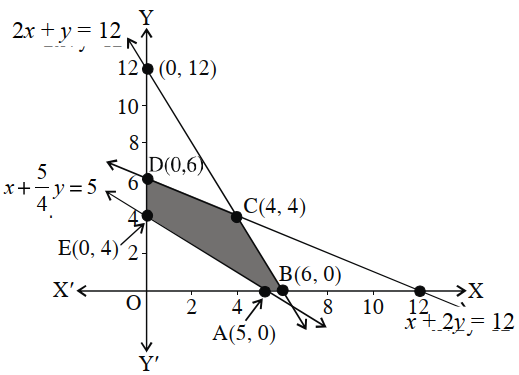
We draw the graph of the constraints (1) to (4). As shown with figure, the feasible region is ABCDE (shaded) which has been determined by the constraints (1) to (4). On observation we find that the feasible region is bounded.
Image
The coordinates of the corner points $A , B , C , D$ and E and respectively $(5,0),(6,0),(4,4),(0,6)$ and $(0,4)$.
Corner PointValue of Z = 60x + 40y
(5,0)300
(6,0)360
(4, 4)400 ← Maximum
(0,6)240
(0,4)1600

We see that at the point (4, 4), the value of Z is maximum.

Need a full question paper?

Generate a complete, print-ready paper with questions like this in minutes — across 16+ boards, with answer keys.

Start Generating Free

Similar questions

Differentiate $\tan^{-1}\Big(\frac{\text{x}-1}{\text{x}+1}\Big)$ with respect to $\sin^{-1}\big(3\text{x}-4\text{x}^3\big),$ if $-\frac{1}{2}<\text{x}<\frac{1}{2}$
Find the image of the point (1, 3, 4) in the plane 2x - y + z + 3 = 0.
If $\vec{\text{a}}$ and $\vec{\text{b}}$ are two non-collinear unit vectors such that $\big|\vec{\text{a}}+\vec{\text{b}}\big|=\sqrt{3},$ find $\big(2\vec{\text{a}}-5\vec{\text{b}}\big).\big(3\vec{\text{a}}+\vec{\text{b}}\big).$
Given the sum of the perimeters of a square and a circle, show that the sum of there areas is least when one side of the square is equal to diameter of the circle.
Find the largest possible area of a right angled triangle whose hypotenuse is 5cm long.
Show that the points whose position vectors are$\vec{\text{a}}=4\hat{\text{i}}-3\hat{\text{j}}+\hat{\text{k}}, \vec{\text{b}}=2\hat{\text{i}}-4\hat{\text{j}}+5\hat{\text{k}},\vec{\text{c}}=\hat{\text{i}}-\hat{\text{j}}$ from a right triangle.
Prove that $\tan^{-1}\bigg(\frac{\sqrt{1+\text{x}^2}+\sqrt{1-\text{x}^2}}{\sqrt{1+\text{x}^2}-\sqrt{1-\text{x}^2}}\bigg)=\frac{\pi}{4}+\frac{1}{2}\cos^{-1}\text{x}^2.$
If $\text{A}=\begin{pmatrix}2&3&1\\1&2&2\\-3&1&-1\end{pmatrix}$, find $A^{-1}$ and hence solve the system of equations $2x + y - 3z =13, 3x + 2y + z = 4, x + 2y - z = 8.$
Find a point on the parabola $y = (x - 4)^2,$ where the tangent is parallel to the chord joining $(4, 0)$ and $(5, 1).$
Prove that in throwing a pair of dice, the occurrence of the number 4 on the first die is independent of the occurrence of 5 on the second die.