Question
Solve the following linear programming problem for minimisation by graphical method :
Objective function
$
\begin{aligned}Z = 5 x + y \\
constraints
3 x + 5 y & \geq 1 5 \\
5 x + 2 y & \leq 1 0 \\
x \geq 0 , y & \geq 0
\end{aligned}
$
Answer

$
Z=5 x+y
$
Constraints are:
$
\begin{aligned}
3 x+5 y & \geq 15 \\
5 x+2 y & \leq 10 \\
x & \geq 0 \\
y & \geq 0
\end{aligned}
$
(i) Region of $3 x+5 y \geq 15$ :
Image
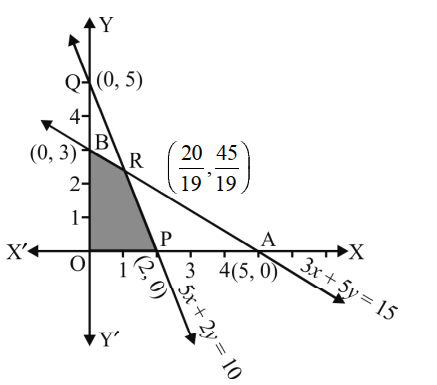
The line $3 x+5 y=15$ passes through the points $A (5,0)$ and $B (0,3)$. Its graph is AB .
Putting $x=0, y=0$ in $3 x+5 y \geq 15$, we get $0 \geq 15$ which is false.
i.e., this region contain AB and region above it.
(ii) Region of $5 x+2 y \leq 10$ :The line $5 x+2 y=10$ passes through the points P $(2,0)$ and $Q (0,5)$. Its graph is PQ .
Now putting $x=0, y=0$ is $5 x+2 y \leq 10$, we get $0 \leq 10$ which is true.
i.e., the region of $5 x+2 y \leq 10$ is the line PQ and below PQ towards the origin.
(iii) The area of $x \geq 0$ is on $y$-axis and to the right of $y$-axis.
(iv) The area of $y \geq 0$ is on $x$-axis and above the $x$-axis.
Thus, the feasible region of this problem is OBRP.
Corner PointCorresponding Value of Z = 5x + y
O(0, 0)0
P(2, 0)10
$R \left(\frac{20}{19}, \frac{45}{19}\right)$$\frac{ 1 4 5 }{ 1 9 }$ Maximum
B(0 , 3)3

Hence, at the corner point O (0, 0) value of Z = 0

Need a full question paper?

Generate a complete, print-ready paper with questions like this in minutes — across 16+ boards, with answer keys.

Start Generating Free

Similar questions

A company manufactures two types of toys A and B. Type A requires 5 minutes each for cutting and 10 minutes each for assembling. Type B requires 8 minutes each for cutting and 8 minutes each for assembling. There are 3 hours available for cutting and 4 hours available for assembling in a day. The profit is Rs. 50 each on type A and Rs. 60 each on type B. How many toys of each type should the company manufacture in a day to maximize the profit?
Find the coordinates of the foot of perpendicular drawn from the point A(1, 8, 4) to the line joining the points B(0, -1, 3) and C(2, -3, -1).
Find the equation of the lines joining the following pairs of vertices and then find the shortest distance between the lines(1) (0, 0, 0) and (1, 0, 2)
(2) (1, 3, 0) and (0, 3, 0)
For the matrix $\text{A}=\begin{bmatrix}1 & -1 & 1 \\2 & 3 & 0 \\ 18 & 2 & 10 \end{bmatrix},$ show that A (adjoint A) = 0.
Evaluate:
$\int\frac{1}{\sin^{4}\text{x} +\sin^{2}\text{x}\cos^{2}\text{x}+\cos^{4}\text{x}}\text{dx}$
The radius of a sphere shrinks from 10 to 9.8cm. Find approximately the decrease in its volume.
Show that $\text{f}(\text{x})=\frac{1}{1+\text{x}^2}$ is neither increasing nor decreasing on R.
If the area enclosed by the parabolas $y^2 - 16ax$ and $x^2 = 16ay, a > 0$ is $\frac{1024}{3}$ square units, find the value of a.
Discuss the continuity and differentiability of the function $\text{f (x) = |x| + x - 1|}$ in the interval (-1, 2).
Find the shortest distance between the following pairs of lines whose cartesian equation are:
$\frac{\text{x}-1}{2}=\frac{\text{y}-2}{3}=\frac{\text{z}-3}{4}$ and $\frac{\text{x}-2}{3}=\frac{\text{y}-3}{4}=\frac{\text{z}-5}{5}$