Question
Solve the following linear programming problem for minimisation by graphical method :
Objective function
$
\begin{aligned}Z = 5 x + y \\
constraints
3 x + 5 y & \geq 1 5 \\
5 x + 2 y & \leq 1 0 \\
x \geq 0 , y & \geq 0
\end{aligned}
$
Answer

$
Z=5 x+y
$
Constraints are:
$
\begin{aligned}
3 x+5 y & \geq 15 \\
5 x+2 y & \leq 10 \\
x & \geq 0 \\
y & \geq 0
\end{aligned}
$
(i) Region of $3 x+5 y \geq 15$ :
Image
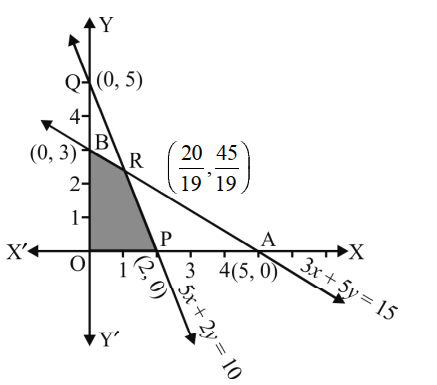
The line $3 x+5 y=15$ passes through the points $A (5,0)$ and $B (0,3)$. Its graph is AB .
Putting $x=0, y=0$ in $3 x+5 y \geq 15$, we get $0 \geq 15$ which is false.
i.e., this region contain AB and region above it.
(ii) Region of $5 x+2 y \leq 10$ :The line $5 x+2 y=10$ passes through the points P $(2,0)$ and $Q (0,5)$. Its graph is PQ .
Now putting $x=0, y=0$ is $5 x+2 y \leq 10$, we get $0 \leq 10$ which is true.
i.e., the region of $5 x+2 y \leq 10$ is the line PQ and below PQ towards the origin.
(iii) The area of $x \geq 0$ is on $y$-axis and to the right of $y$-axis.
(iv) The area of $y \geq 0$ is on $x$-axis and above the $x$-axis.
Thus, the feasible region of this problem is OBRP.
Corner PointCorresponding Value of Z = 5x + y
O(0, 0)0
P(2, 0)10
$R \left(\frac{20}{19}, \frac{45}{19}\right)$$\frac{ 1 4 5 }{ 1 9 }$ Maximum
B(0 , 3)3

Hence, at the corner point O (0, 0) value of Z = 0

Need a full question paper?

Generate a complete, print-ready paper with questions like this in minutes — across 16+ boards, with answer keys.

Start Generating Free

Similar questions

Evaluate the following definite integral as limit of sum:$\int_\limits{0}^{4}\text{(x}+\text{e}^{2\text{x}})\ \text{dx}$
In a certain college, $4\%$ of boys and $1\%$ of girls are taller than $1.75$ metres. Further more, $60\%$ of the students in the colleges are girls. A student selected at random from the college is found to be taller than $1.75$ metres. Find the probability that the selected students is girl.
Find the equations of the tangent and the normal to the following curves at the indicated points.
$\frac{\text{x}^2}{\text{a}^2}+\frac{\text{y}^2}{\text{b}^2}=1\text{ at }(\text{a}\cos\theta,\text{b}\sin\theta)$
Maximum Z = 4x + 3y
Subject to
$3\text{x}+4\text{y}\leq24$
$8\text{x}+6\text{y}\leq48$
$\text{x}\leq5$
$\text{y}\leq6$
$\text{x},\text{y}\geq0$
Solve the following differential equation:
$(\text{x}+\text{y}+1)\frac{\text{dy}}{\text{dx}} = 1$
Find the shortest distance between the lines
$\vec{\text{r}}=\big(\hat{\text{i}}+2\hat{\text{j}}+\hat{\text{k}}\big)+\lambda\big(\hat{\text{i}}-\hat{\text{j}}+\hat{\text{k}}\big)$ and, $\vec{\text{r}}=2\hat{\text{i}}-\hat{\text{j}}-\hat{\text{k}}+\mu\big(2\hat{\text{i}}+\hat{\text{j}}+2\hat{\text{k}}\big)$
In each of the show that the given differential equation is homogeneous and solve each of them.
$\text{y dx}+\text{x}\log\bigg(\frac{\text{y}}{\text{x}}\bigg)\text{dy}-2\text{x}\ \text{dy}=0$
If $\text{x}\sqrt{1+\text{y}}+\text{y}\sqrt{1+\text{x}}=0,$ prove that $(1+\text{x})^2\frac{\text{dx}}{\text{dx}}+1=0$
Evaluate the following integrals:
$\int^\limits\frac{\pi}{2}_0\text{x}^2\sin\text{x dx}$
Find the area of the region $\{(\text{x},\text{y}):\text{x}^2+\text{y}^2\leq4,\text{x}+\text{y}\geq2\}$