Question
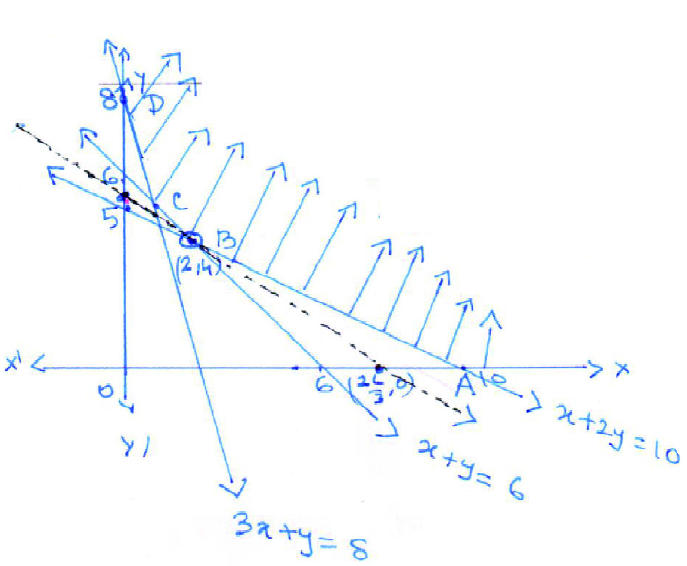
Solve the following linear programming problem graphically.Minimise $\text{z = 3x + 5y}$
subject to the constraints
$\text{x + 2y}\geq 10$
$\text{x + y}\geq 6$
$\text{3x + y}\geq 8$
$\text{x, y}\geq 0.$
Answer


Vertices are A (10, 0), 2, 4 ), C(1, 5) & D (0, 8)$\text{Z = 3 x + 5y}$ is minimum
at B (2, 4) and the minimum Value is 26.
on Ploting $\text{(3x + 5y < 26)}$
since these it no common point with the feasible
region, Hence, $\text{x = 2, y = 4}$ gives minimum Z

Need a full question paper?

Generate a complete, print-ready paper with questions like this in minutes — across 16+ boards, with answer keys.

Start Generating Free

Similar questions

Differentiate the following functions with respect to x:
$\sin(2\sin^{-1}\text{x})$
Find the area enclosed between the parabola $y^2 = 4ax$ and the line $y = mx$.
$\overrightarrow{\text{n}}$ is a vector of magnitude $\sqrt{3}$ and is equally inclined to an acute angle with the coordinate axes. Find the vector and cartesian form of the equation of a plane which passes through (2, 1, -1) and is normal to $\overrightarrow{\text{n}}$
Differentiate the following functions with respect to x:
$\cos^{-1}\Big\{\sqrt{\frac{1+\text{x}}{2}}\Big\},-1<\text{x}<1$
Solve the following systems of linear equations by cramer's rule:
2x - y = 1,
7x - 2y = -7
If there is an error of 0.1% in the measurement of the radius of a sphere, find approximately the percentage error in the calculation of the volume of the sphere.
Differentiate the following functions with respect to x:
$\text{e}^{\text{x}\log\text{x}}$
Find the shortest distance between the following pairs of parallel lines whose equations are:$\vec{\text{r}}=\big(\hat{\text{i}}+2\hat{\text{j}}+3\hat{\text{k}}\big)+\lambda\big(\hat{\text{i}}-\hat{\text{j}}+\hat{\text{k}}\big)$ and $\vec{\text{r}}=\big(2\hat{\text{i}}-\hat{\text{j}}-\hat{\text{k}}\big)+\mu\big(-\hat{\text{i}}+\hat{\text{j}}-\hat{\text{k}}\big)$
Find the equations of the tangent and the normal to the following curves at the indicated points.
$\text{x}^{\frac{2}{3}}+\text{y}^{\frac{2}{3}}=2\text{ at }(1,1)$
Show that the set of all prime numbers is infinite.