Question
✓
Answer
To draw the feasible region, construct table as follows:
| Inequality | $x \leq 3$ | $y \leq 3$ | $x+y \leq 5$ |
| Corresponding equation (of line) | x = 3 | y = 3 | x + y = 5 |
| Intersection of line with X-axis | (3, 0) | – | (5, 0) |
| Intersection of line with Y-axis | – | (0, 3) | (0, 5) |
| Region | Origin side | Origin side | Origin side |
Shaded portion OABCD is the feasible region,
whose vertices are O(0, 0), A(3, 0), B, C and D(0, 3)
B is the point of intersection of the lines x = 3 and x + y = 5.
Substituting x = 3 in x + y = 5, we get y = 2
$\therefore B \equiv(3,2)$
C is the point of intersection of the lines y = 3 and x + y = 5.
Substituting y = 3 in x + y = 5, we get
x = 2
$\therefore C \equiv(2,3)$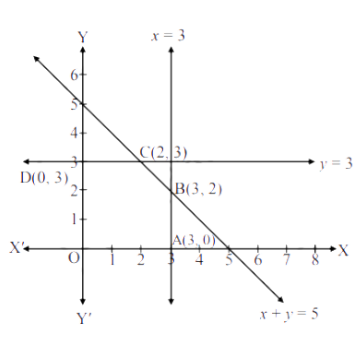
Here, the objective function is Z = 10x + 25y
$\therefore Z$ at $O(0,0)=10(0)+25(0)=0$
Z at A(3, 0) = 10(3) + 25(0) = 30
Z at B(3, 2) = 10(3) + 25(2) = 30 + 50 = 80
Z at C(2, 3) = 10(2) + 25(3) = 20 + 75 = 95
Z at D(0, 3) = 10(0) + 25(3) = 75
$\therefore$Z has maximum value 95 at C(2, 3).
$\therefore$Z is maximum, when x = 2 and y = 3.
Need a full question paper?
Generate a complete, print-ready paper with questions like this in minutes — across 16+ boards, with answer keys.
Explore more
Similar questions
Evaluate: $\int_{\frac{1}{\sqrt{2}}}^1 \frac{\left( e ^{\left.\cos ^{-1} x\right)\left(\sin ^{-1} x\right)}\right.}{\sqrt{1-x^2}} d x$
→The p.m.f. for $X =$ number of major defects in a randomly selected appliance of a certain type is
Find the expected value and variance of $X$.
→| $X =x$ | 0 | 1 | 2 | 3 | 4 |
| $P (x = x)$ | 0.08 | 0.15 | 0.45 | 0.27 | 0.05 |
Find the expected value and variance of $X$.
A line makes angles of measure $45^{\circ}$ and $60^{\circ}$ with positive direction of $y$ and $z$ axes respectively. Find the d.c.s. of the line and also find the vector of magnitude 5 along the direction of line.
→A horticulturist wishes to mix two brands of fertilizers that will provide a minimum of 15 units of potash, 20 units of nitrate and 24 units of phosphate. One unit of brand I provides 3 units of potash, 1 unit of nitrate, 3 units of phosphate. One unit of brand II provides 1 unit of potash, 5 units of nitrate and 2 units of phosphates. One unit of brand I costs Rs. 120 and one unit of brand II costs Rs.60 per unit. Formulate this problems as L.P.P. to minimize the cost.
A firm manufactures two products $A$ and $B$ on which profit earned per unit are $₹.3$ and $₹.4$ respectively. Each product is processed on two machines $M_1$ and $M_2$. The product A requires one minute of processing time on $M_1$ and two minutes on $M_2$, while product $B$ requires one minute on $M_1$ and one minute on $M_2$. Machine $M_1$ is available for use not more than $450$ minutes, while $M_2$ is available for $600$ minutes during any working day. Find the number of units of product $A$ and $B$ to be manufactured to get the maximum profit.
→A rod of 108 meters long is bent to form a rectangle. Find its dimensions when it's area is maximum.
If $\sqrt{1-x^2}+\sqrt{1-y^2}=a(x-y)$, then show that $\frac{d y}{d x}=\sqrt{\frac{1-y^2}{1-x^2}}$.
→The cost of $2$ books, $6$ notebooks and $3$ pens is $₹ 40$ . The cost of $3$ books, $4$ notebooks and $2$ pens is $₹ 35$ , while the cost of $5$ books, $7$ notebooks and $4$ pens is $₹ 61$ . Using this information and matrix method, find the cost of $1$ book, $1$ notebook and $1$ pen separately.
→Integrate the following functions w.r.t x:
→$\frac{1}{\sin x \cdot \cos x+2 \cos ^2 x}$
Find the volume of the parallelopiped whose vertices are $A (3, 2, -1), B (-2, 2, -3) C (3, 5, -2)$ and $D (-2, 5, 4).$
→