Question
Solve the following L.P.P. graphically:
$\text{Minimise} \text{ }\text{ }\text{ }\text{Z} = 5x + 10\text{y}\\\text{Subect to} \text{ }\text{ }\text{ }\text{ }\text{ }x + \text{2y} \leq 120\\\text{Constraints} \text{ }x + \text{y} \geq 60\\\text{ }\text{ }\text{ }\text{ }\text{ }\text{ }\text{ }\text{ }\text{ }\text{ }\text{ }\text{ }\text{ }\text{ }\text{ }\text{ }\text{ }\text{ }\text{ }\text{ }\text{ }x - \text{2y} \geq 0\\\text{ }\text{ }\text{ }\text{ }\text{ }\text{ }\text{and}\text{ }\text{ }\text{ }\text{ }\text{ }\text{ }\text{ }\text{ }x, \text{y} \geq 0$
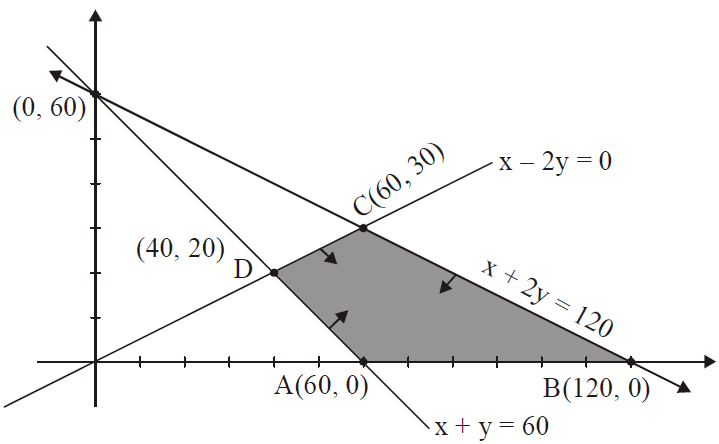
Answer


$Z = 5x + 10y$
$Z|_{A(60, 0)} = 300$
$Z|_{B(120, 0)} = 600$
$Z|_{C(60, 30)} = 60$
$Z|_{D(40, 20}) = 400$
Minimum value of $Z = 300$ at $x = 60, y = 0$

Need a full question paper?

Generate a complete, print-ready paper with questions like this in minutes — across 16+ boards, with answer keys.

Start Generating Free

Similar questions

There are two bags, one of which contains $3$ black and $4$ white balls while the other contains $4$ black and $3$ white balls. A die is thrown. If it shows up $1$ or $3$, a ball is taken from the Ist bag; but it shows up any other number, a ball is chosen from the second bag. Find the probability of choosing a black ball.
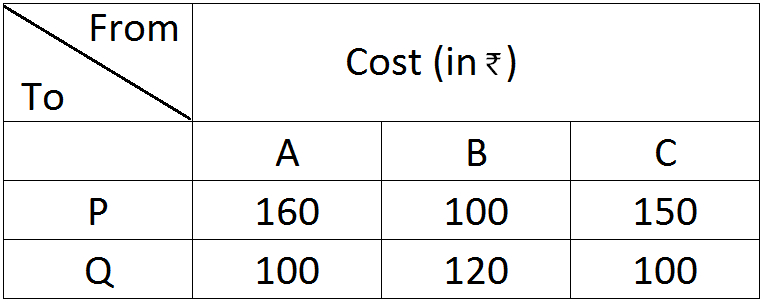
There are two factories located one at place P and the other at place Q. From these locations, a certain commodity is to be delivered to each of the three depots situated at A, B and C. The weekly requirements of the depots are respectively 5, 5 and 4 units of the commodity while the production capacity of the factories at P and Q are respectively 8 and 6 units. The cost of transportation per unit is given below:
How many units should be transported from each factory to each depot in order that the transportation cost is minimum. What will be the minimum transportation cost?
If $\text{xy}\log(\text{x}+\text{y})=1,$ prove that $\frac{\text{dx}}{\text{dx}}=-\frac{\text{y}(\text{x}^2\text{y}+\text{x}+\text{y})}{\text{x}(\text{xy}^2+\text{x}+\text{y})}$
$\begin{vmatrix}0&\text{b}^2\text{a}&\text{c}^2\text{a}\\\text{a}^2\text{b}&0&\text{c}^2\text{b}\\\text{a}^2\text{c}&\text{b}^2\text{c}&0\end{vmatrix}=2\text{a}^3\text{b}^3\text{c}^3$
Prove that the curves $y^2=4 x$ and $x^2=4 y$ divide the area of the square bounded by sides $x=0, x=4, y=4$ and $y =0$ into three equal parts.
Solve the following differential equation
$\frac{\text{dy}}{\text{dx}}+\frac{1+\text{y}^2}{\text{y}}=0$
AB is the diameter of a circle and C is any point on the circle. Show that the area of triangle ABC is maximum, when it is an isosceles triangle.
verify that $\text{y}=\text{-x}-1$ is a solution of the differential equation $(\text{y}-\text{x})\text{dy}-(\text{y}^2-\text{x}^2)\text{dx}=0.$
Three bags contain balls as shown in the table below:
Bag Number of White balls Number of Black balls Number of Red balls
I 1 2 3
II 2 1 1
III 4 3 2
A bag is chosen at random and two balls are drawn from it. They happen to be white and red. What is the probability that they came from the III bag?
In a culture, the bacteria count is 1,00,000. The number is increased by 10% in 2 hours. In how many hours will the count reach 2,00,000, if the rate of growth of bacteria is proportional to the number present?