Question
Solve the following quadratic equation:$3\text{x}^2-2\sqrt6\text{x}+2=0$

Answer

$3\text{x}^2-2\sqrt6\text{x}+2=0$$\Rightarrow​​3\text{x}^2-\sqrt6\text{x}-\sqrt6\text{x}+2=0$
$\Rightarrow\sqrt3\text{x}\big(\sqrt3\text{x}-\sqrt2\big)-\sqrt2\big(\sqrt3\text{x}-\sqrt2\big)=0$
$\Rightarrow\big(\sqrt3\text{x}-\sqrt2\big)\big(\sqrt3\text{x}-\sqrt2\big)=0$
$\Rightarrow\big(\sqrt3\text{x}-\sqrt2\big)^2=0$
$\Rightarrow\sqrt3\text{x}-\sqrt2=0$
$\Rightarrow\text{x}=\frac{\sqrt2}{\sqrt3}$ (repeated root)

Need a full question paper?

Generate a complete, print-ready paper with questions like this in minutes — across 16+ boards, with answer keys.
Start Generating Free

Similar questions

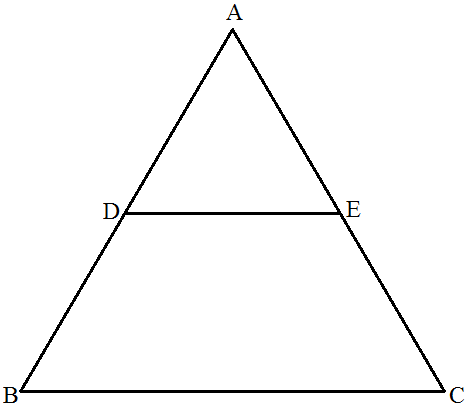
In a $\triangle\text{ABC,D}\ \text{and E}$ are points on the sides AB and AC respectively such that DE || BC.If AD = 4x - 3, AE = 8x - 7, BD = 3x - 1 and CE = 5x - 3, find the value of x.
The sums of first $n$ terms of three A.P. $S$ are $S_1, S_2$ and $S_3$. The first term of each is 5 and their common differences are 2,4 and 6 respectively. Prove that $S_1+S_3=2 S_2$.
A solid metallic hemisphere of radius 8cm is melted and recasted into a right circular cone of base radius 6cm. Determine the height of the cone.
If a $\triangle\text{ABC},$ AD is the bisector of $\angle\text{A},$ Meeting side BC at D.
If AC = 4.2cm, DC = 6cm and BC = 10cm, find AB.
The sum of three terms of an $A.P.$ is $21$ and the product of the first and the third terms exceeds the second term by $6$, find three terms.
The sum of the first n terms of an AP is $\Big(\frac{5\text{n}^2}{2}+\frac{3\text{n}}{2}\Big).$ Find the $n^{th}$ term and the $20^{th}$​​​​​​​ term of this AP.
If two positive integers $p$ and $q$ are written as $p=a^2 b^3$ and $q=a^3 b,a$ and $b$ are a prime number then.Verify.$\ce{LCM} \times (p.q. ) \times \operatorname{HCF}(p.q.)=p q$
In the given figure, DE || BC
If DE : BC = 3 : 5. Calculate the ratio of the areas of $\triangle\text{ADE}$ and the trapezium BCED.
Verify that the numbers given along side of the cubic polynomials below are their zeros. Also, verify the relationship between the zeros and coefficients in each case:
$\text{g}(\text{x})=\text{x}^3-4\text{x}^2+5\text{x}-2;2,2,1,1$
Two years ago, Salim was thrice as old as his daughter and six years later, he will be four years older than twice her age. How old are they now?