Question
Solve the following quadratic equation by factorization method:
$3  y^2-14 y+8=0$

Answer

$y=4$ or $y=\frac{2}{3}$

Need a full question paper?

Generate a complete, print-ready paper with questions like this in minutes — across 16+ boards, with answer keys.
Start Generating Free

Similar questions

A bag contains 18 balls out of which x balls are red.
  1. If one ball is drawn at random from the bag, what is the probability that it is not red?
  2. If two more red balls are put in the bag, the probability of drawing a red ball will be $\frac{9}{8}$ times the probability of drawing a red ball in the first case. Find the value of x.
Find the sum of the following APs:
$\frac{1}{15},\frac{1}{12},\frac{1}{10},\ ....$ to 11 terms.
Find the $n^{th}$​​​​​​​ term of the following APs:
$5, 11, 17, 23,....$
There are 15 tickets in a box, each bearing one of the numbers from 1 to 15. One ticket is drawn at random from the box. Find the probability of event that the ticket drawn -
shows a number which is a multiple of 5.
Calculate the mean for the following distribution:
x 5 6 7 8 9
f 4 8 14 11 3
If $\text{x}=\text{a}\sin\theta+\text{b}\cos\theta$ and $\text{y}=\text{a}\cos\theta-\text{b}\sin\theta,$ prove that $\text{x}^2+\text{y}^2=\text{a}^2+\text{b}^2.$
Write sample space ‘S’ and number of sample point n(S) for each of the following experiments. Also write events A, B, C in the set form and write n(A), n(B), n(C).
One die is rolled,
Event A : Even number on the upper face.
Event B : Odd number on the upper face.
Event C : Prime number on the upper face.

Without actually performing the long division, state whether state whether the following rational numbers will have a terminating decimal expansion or a non terminating repeating decimal expansion.
$\frac{129}{2^2\times5^7\times7^{17}}$
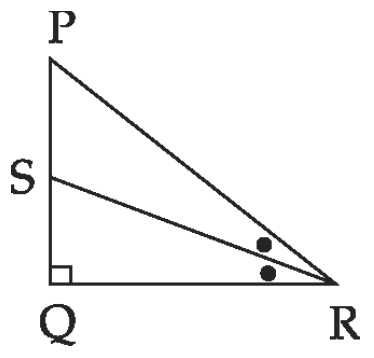
In $\Delta$PQR, seg RS is bisector of $\angle P R Q$ PS = 6, SQ = 8, PR = 15. Find QR.
Image
If $\sin \theta = \frac{11}{61}$, find the values of $\cos \theta$ using trigonometric identity.