Question
Solve the following quadratic equation by factorization method:
$x^2-3 \sqrt{3} x+6=0$

Answer

$x=\sqrt{3}$ or $x=2 \sqrt{3}$

Need a full question paper?

Generate a complete, print-ready paper with questions like this in minutes — across 16+ boards, with answer keys.
Start Generating Free

Similar questions

Prove that $\frac{\cos \theta}{1+\sin \theta}=\frac{1-\sin \theta}{\cos \theta}$
The sides of certain triangles are given below. Determine which of them are right triangles.
$a = 9\ cm, b = 16\ cm$ and $c = 18\ cm$.
Which of the following sequences are A.P. ? If they are A.P. find the common difference.
$– 10, – 6, – 2, 2, . . .$
In a circle of radius 6cm, a chord of length 10cm makes an angle of 110° at the centre of the circle. Find:
The area of the circle.
Write sample space ‘S’ and number of sample point n(S) for each of the following experiments. Also write events A, B, C in the set form and write n(A), n(B), n(C).
Two digit numbers are formed using digits 0, 1, 2, 3, 4, 5 without repetition of the digits.
Condition for event A : The number formed is even
Condition for event B : The number formed is divisible by 3.
Condition for event C : The number formed is greater than 50.

A drinking glass is in the shape of the frustum of a cone of height 21cm with 6cm and 4cm as the diameters of its two circular ends. Find the capacity of the glass.
Which of the following sequences are A.P. ? If they are A.P. find the common difference.
$2, \frac{5}{2}, 3, \frac{7}{3}, \ldots$
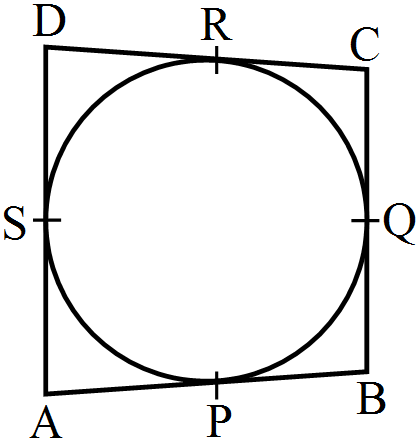
In the given figure, a quadrilateral ABCD is drawn to circumscribe a circle such that its side AB, BC, CD and AD touch the circle at P, Q, R and S respectively. If AB = x cm, BC = 7cm, CR = 3cm and AS = 5cm , find x.
Mr. Deshmukh's investment in shares is given below. Find his total investment in shares.

Company A: 450 shares, face value $= \imath 100$
Premium $=₹ 25$
Company B: 500 shares, face value $-₹ 100$
Market Value = ₹ 205
Company C: 80 shares, face value $-₹ 100$
Discount $=₹ 15$
A(h, -6), B(2, 3) and C(-6, k) are the co-ordinates of vertices of a trianglewhose centroid is G (1, 5). Find h and k.