Question
Solve the following quadratic equation by factorization.
$2 x^2-2 x+\frac{1}{2}=0$

Answer


$\begin{array}{l}
2 x ^2-2 x +\frac{1}{2}=0 \\
\Rightarrow 4 x ^2-4 x +1=0 \\
\Rightarrow 4 x ^2-2 x -2 x +1 \\
\Rightarrow 2 x(2 x-1)-1(2 x-1) \\
\Rightarrow(2 x-1)(2 x-1) \\
\Rightarrow 2 x-1=0 \Rightarrow x=\frac{1}{2}, \frac{1}{2}
\end{array}$
Hence $x=\frac{1}{2}, \frac{1}{2}$ are roots of the equation

Need a full question paper?

Generate a complete, print-ready paper with questions like this in minutes — across 16+ boards, with answer keys.
Start Generating Free

Similar questions

Write the correct alternative for the following question.
If the Face Value of a share is Rs. 100 and Market value is Rs. 75,then which of the following statements is correct?
A. The share is at premium of Rs. 175
B. The share is at discount of Rs. 25
C. The share is at premium of Rs. 25
D. The share is at discount of Rs. 75
Find the $37^{th}$ term of the AP $6,7\frac{3}{4},9\frac{1}{2},11\frac{1}{4},\ ...$
The points $A \left( x _1, y _1\right), B \left( x _2, y _2\right)$ and $C \left( x _3, y _3\right)$ are the vertices of $\triangle A B C$.
What are the coordinates of the centroid of the triangle $A B C$ ?
Which of the following sequences are A.P. ? If they are A.P. find the common difference.
$0.3, 0.33, .0333, . . .$
Find the largest number which divides $320$ and $457$ leaving remainders $5$ and $7$ respectively.
Prove the following.
tan4θ + tan2θ = sec4θ - sec2θ

Which of the following sequences are arithmetic progressions. For those which are arithmetic progressions,
find out the common difference.
$0, -4, -8, -12$, .....
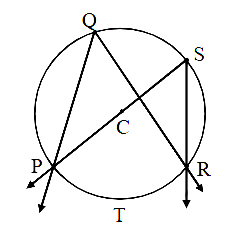
Prove that angles inscribed in the same arc are congruent.

Given: In a circle with center $C, \angle P Q R$ and $\angle P S R$ are inscribed in same arc PQR. Arc PTR is intercepted by the angles.
To prove: $\angle P Q R \cong \angle P S R$.
Proof:
$ m \angle PQR =\frac{1}{2} \times[ m (\operatorname{arc} PTR )]$
$m \angle \square=\frac{1}{2} \times[ m (\operatorname{arc} PTR )] \ldots . . . \text { (ii) } \square$
$m \angle \square= m \angle PSR \quad \ldots . . .[ By \text { (i) and (ii) }]$
$\therefore \angle PQR \cong \angle PSR $
Decide whether x = 2 and y =−1 is the solution of the equation 2x + y = 3 or not?
Solve the following quadratic equation:$\sqrt3\text{x}^2+\text{11x}+6\sqrt3=0$