Question
Solve the following quadratic equation:
$\sqrt3\text{x}^2+\text{11x}+6\sqrt3=0$

Answer

$\sqrt3\text{x}^2+\text{11x}+6\sqrt3=0$
Here, $6\sqrt3\times\sqrt3=6\times3=18$ and $9 \times 2 = 18$ & $9 + 2 = 11$
$\Rightarrow\sqrt3\text{x}^2+\text{11x}+6\sqrt3=0$
$\Rightarrow​​\sqrt3\text{x}^2+9\text{x}+2\text{x}+6\sqrt3=0$
$\Rightarrow\sqrt3\text{x}\big(\text{x}+3\sqrt3\big)+2\big(\text{x}+3\sqrt{3}\big)$
$\Rightarrow\big(\text{x}+3\sqrt{3}\big)\big(\sqrt3\text{x}+2\big)=0$
$\Rightarrow\text{x}+3\sqrt3=0$ or $\sqrt3\text{x}+2=0$
$\Rightarrow\text{x}=-3\sqrt3$ or $\text{x}=\frac{-2}{\sqrt3}$
$\Rightarrow\text{x}=-3\sqrt3$ or $\text{x}=\frac{-2\times\sqrt3}{\sqrt3\times\sqrt3}=\frac{-2\sqrt3}{3}$
Hence, $-3\sqrt3$ and $\frac{-2\sqrt3}{3}$ are the roots of the given equation.

Need a full question paper?

Generate a complete, print-ready paper with questions like this in minutes — across 16+ boards, with answer keys.
Start Generating Free

Similar questions

Use Euclid's division algorithm to find the $HCF$ of:
$136, 170$ and $255$
Very-Short and Short-Answer Questions.
If $\tan\text{A}=\frac{5}{12},$ find thew value of $(\sin\text{A}+\cos\text{A})\sec\text{A}.$
The distributions $X$ and $Y$ with total number of observations $36$ and $64,$ and mean $4$ and $3$ respectively are combined. What is the mean of resulting distribution $X + Y?$
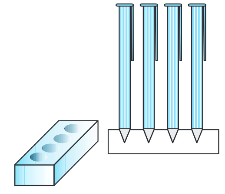
A pen stand made of wood is in the shape of a cuboid with four conical depressions to hold pens. The dimensions of the cuboid are $15\ cm$ by $10\ cm$ by $3.5\ cm$. The radius of each of the depressions is $0.5\ cm$ and the depth is $1.4\ cm$. Find the volume of wood in the entire stand.
Find the largest four-digits number which when divided by $4, 7$ and $13$ leaves a reminder of $3$ in each case.
Check whether $(5, –2), (6, 4)$ and $(7, –2)$ are the vertices of an isosceles triangle.
On comparing the ratios $ \frac { a _ { 1 } } { a _ { 2 } } , \frac { b _ { 1 } } { b _ { 2 } } \text { and } \frac { c _ { 1 } } { c _ { 2 } }$, find out whether the lines representing the pair of linear equations intersect at a point, are parallel or coincide: $6x − 3y + 10 = 0; 2x – y + 9 = 0.$
State whether the following are true or false. Justify your answer.
The value of $\tan A$ is always less than $1.$
A card is drawn at random from a pack of $52$ cards. Find the probability that the card drawn is:
A black card.
Is the given sequence $a, 2a, 3a, 4a,...$ forms an $AP?$ If it forms an $AP$, then find the common difference $d$ and write the next three terms.