Question
Solve the following quadratic equation:
$\frac{\text{a}}{(\text{x}-\text{b})}+\frac{\text{b}}{(\text{x}-\text{a})}=2,$ $\text{x}\neq-\text{b},\ \text{a}$
Answer

The given equation:
$\Big(\frac{\text{a}}{\text{x}-\text{b}}-1\Big)+\Big(\frac{\text{b}}{\text{x}-\text{a}}-1\Big)=0$
$\Rightarrow\frac{(\text{a}-\text{x}+\text{b})}{(\text{x}-\text{b})}+\frac{(\text{b}-\text{x}+\text{a})}{(\text{x}-\text{a})}=0$
$\Rightarrow(\text{a}-\text{x}+\text{b})\Big[\frac{1}{(\text{x}-\text{b})}+\frac{1}{(\text{x}-\text{a})}\Big]=0$
$\Rightarrow(\text{a}-\text{x}+\text{b})\Big[\frac{\text{2x}-(\text{a}+\text{b})}{(\text{x}-\text{a})(\text{x}-\text{b})}\Big]=0$
$\Rightarrow(\text{a}-\text{x}+\text{b})[\text{2x}-(\text{a}+\text{b})]=0$
$\Rightarrow\text{x}=(\text{a}+\text{b})$ or $\text{x}=\frac{(\text{a}+\text{b})}{2}$
Hence, (a + b) and $\frac{(\text{a}+\text{b})}{2}$ is the root of the given equation.

Need a full question paper?

Generate a complete, print-ready paper with questions like this in minutes — across 16+ boards, with answer keys.

Start Generating Free

Similar questions

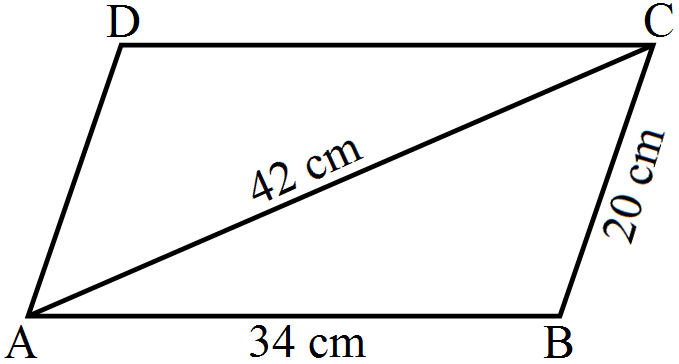
The adjacent sides of a parallelogram ABCD measure 34cm and 20cm, and the diagonal AC measures 42cm. Find the area of the parallelogram.
Solve the following system of equations graphically:
x + 2y + 2 = 0,
3x + 2y - 2 = 0
Find the mode, median and mean for the following data:
Marks obtained
25-35
35-45
45-55
55-65
65-75
75-85
Number of students
7
31
33
17
11
1
​The following table shows the marks scored by 80 students in an examination:
Marks
Less than 5
Less than 10
Less than 15
Less than 20
Less than 25
Less than 30
Less than 35
Less than 40
Number of students
3
10
25
49
65
73
78
80
Calculate the mean marks correct to 2 decimal places.
To construct a triangle similar to $\triangle\text{ABC}$ in which BC = 4.5cm, $\angle\text{B}=45^\circ$ and $\angle\text{C}=60^\circ,$ using a scale factor of $\frac35$ BC will be divided in the ratio.
  1. 3 : 4
  2. 4 : 7
  3. 3 : 10
  4. 3 : 7
Solve for x and y:
$\frac{3}{\text{x}}-\frac{1}{\text{y}}+\text{9}=0,$
$\frac{2}{\text{x}}+\frac{3}{\text{y}}=\text{5}$ $(\text{x}\neq0,\ \text{y}\neq0).$
A right circular cone is divived into three parts by trisecting its height by two planes drawn parallel to the base. show that the volumes of the three portions starting from top are in ratio 1 : 7 : 19.
The following table gives the production yield per hectare of wheat of 100 farms of a village.
Production yield (kg/ha)
50-55
55-60
60-65
65-70
70-75
75-80
Number of farms
2
8
12
24
38
16
Change the distribution to a 'more than type' distribution and draw its ogive. Using ogive, find the median of the given data.
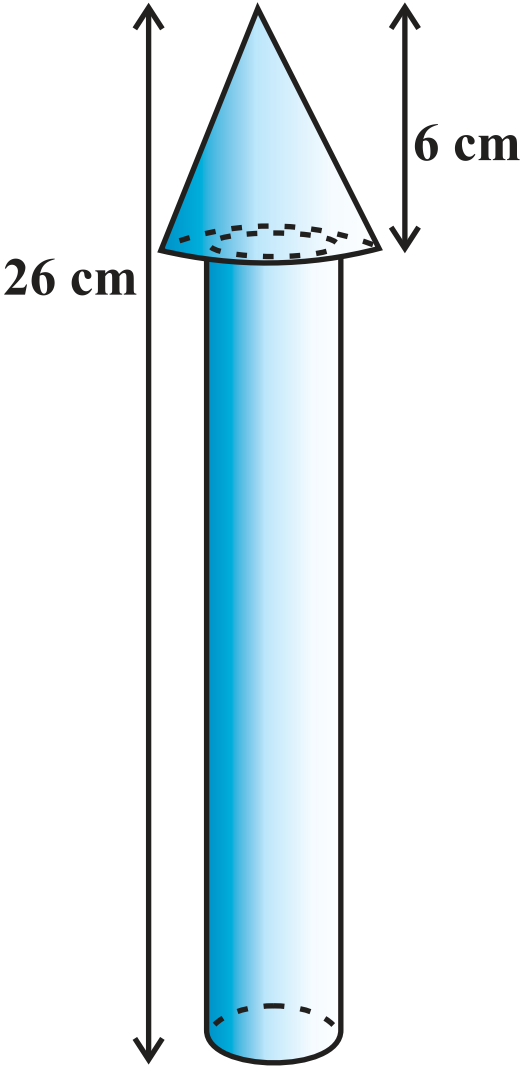
A wooden toy is in the shape of a cone mounted on a cylinder, as shown in the figure. The total height of the toy is 26cm, while the height of the conical part is 6cm. The diameter of the base of the conical part is 5cm and that of the cyliridrical part is 4cm. The conical part and the cylindrical part are respectively painted red and white. Find the area to be painted by each of these colours. $\big[$Take $\pi=\frac{22}{7}\big]$
If $5\text{A}=\text{cosec }(\text{A}-36^\circ)$ and $5\text{A}$ is an acute angle, show that $\text{A}=21^\circ.$