Question
Solve the following quadratic equation:$\text{x}^2-\big(1+\sqrt2\big)\text{x}+\sqrt2=0$

Answer

$\text{x}^2-\big(1+\sqrt2\big)\text{x}+\sqrt2=0$
$\Rightarrow\text{x}^2-1.\text{x}-\sqrt2\text{x}+\sqrt2=0$
$\Rightarrow\text{x}(\text{x}-1)-\sqrt2(\text{x}-1)=0$
$\Rightarrow(\text{x}-1)\big(\text{x}-\sqrt2\big)=0$
$\Rightarrow(\text{x}-1)=0$ or $\text{x}-\sqrt2=0$
$\Rightarrow\text{x}=1$ or $\text{x}=\sqrt2$
Hence, 1 and $\sqrt2$ are the roots of the given equation.

Need a full question paper?

Generate a complete, print-ready paper with questions like this in minutes — across 16+ boards, with answer keys.

Start Generating Free

Similar questions

Determine the mean of the following distribution:
Marks
Number of students
Below 10
Below 20
Below 30
Below 40
Below 50
Below 60
Below 70
Below 80
Below 90
Below 100
5
9
17
29
45
60
70
78
83
85
Find the smallest number which when increased by $17$ is exactly divisible by both $520$ and $468.$
A vessel is in the form of a hemispherical bowl surmounted by a hollow cylinder. The diameter of the hemisphere is 21cm and the total height of the vesel is 14.5cm. find its capacity.
Given $\tan\theta=\frac{1}{\sqrt{5}},$ what is the value of $\frac{\text{cosec}^2\theta-\sec^2\theta}{\text{cosec}^2\theta+\sec^2\theta}?$
A jar contains 24 marbles. Some of these are green and others are blue. If a marble is drawn at random from the jar, the probability that it is green is $\frac{2}{3}.$ Find the number of blue marbles in the jar.
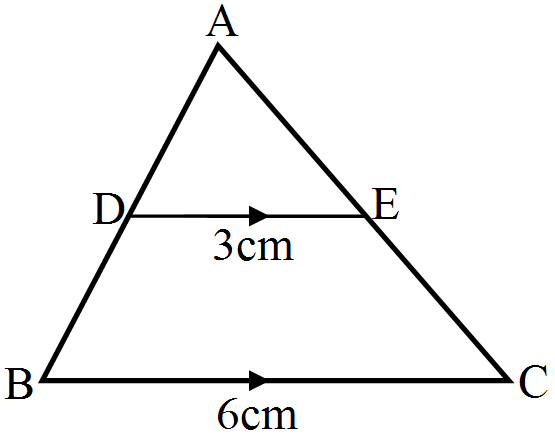
In the given figure, DE || BC. If DE = 3cm, BC = 6cm and $\text{ar}(\triangle\text{ADE})=15\text{cm}^2,$ find the area of $\triangle\text{ABC}.$
A solid wooden toy is in the form of a hemisphere surmounted by a cone of same radius. The radius of hemisphere is $3.5 \ cm$ and the total wood used in the making of toy is $166 \frac{5}{6} \ cm^3$. Find the height of the toy. Also, find the cost of painting the hemispherical part of the toy at the rate of $Rs. 10\ \text { per } \ cm^2 \cdot\left[\text { Use } \pi=\frac{22}{7}\right]$
Solve the pair of linear equations by substitution method: 0.2x + 0.3y = 1.3; 0.4x + 0.5y = 2.3
Prove the following trigonometric identities.
$\sqrt{\frac{\sec\theta-1}{\sec\theta+1}}+\sqrt{\frac{\sec\theta+1}{\sec\theta-1}}=2 \text{cosec }\theta$
Find the value of k for which the following equation have real root:
$x^2 - 4kx + k = 0$