Question
Solve the following quadratic equation using formula method only
$3 x ^2-5 x +\frac{25}{12}=0$

Answer

$3 x ^2-5 x +\frac{25}{12}=0$
$ a =3 ; b =-5 ; c =\frac{25}{12} $
$ D = b ^2-4 ac$
$ =(-5)^2-4(3)\left(\frac{25}{12}\right) $
$ =25-25 $
$=0 $
$ x =\frac{- b \pm \sqrt{ b ^2-4 ac }}{2 a} $
$x =\frac{-(-5) \pm 0}{6} $
$x =\frac{5}{6}$

Need a full question paper?

Generate a complete, print-ready paper with questions like this in minutes — across 16+ boards, with answer keys.
Start Generating Free

Similar questions

Find the coordinate of a point P which divides the line segment joining :
$5(2, 6)$ and $R(9, -8)$ in the ratio $3: 4.$
Two dice are thrown simultaneously. Find the probability of getting: an even number as the sum.
Salman buys 50 shares of face value Rs 100 available at Rs 132.
(i) What is his investment?
(ii) If the dividend is 7.5% p.a., what will be his annual income?
(iii) If he wants to increase his annual income by Rs 150, how many extra shares should he
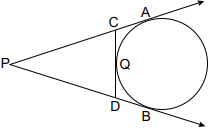
In the figure, PA and PB are tangents to the circle drawn from an external point P. CD is another tangent touching the circle at Q. If PA = PB = 12 cm and QD = 3 cm, find the length of PD.
Image
Find the coordinates of the points of trisection (i.e., points dividing into three equal parts) of the line segment joining the points $A (2,-2)$ and $B (-7,4)$
Prove the following identitie:
$(1 + \tan A + \sec A)(1 + \cot A - \cos ec A) = 2$
The lines represented by $4x + 3y = 9$ and $px - 6y+ 3 = 0$ are parallel. Find the value of $p.$
Prove that $\frac{\cot A+\operatorname{cosec} A-1}{\cot A-\operatorname{cosec} A+1}=\frac{1+\cos A}{\sin A}$
The age of 40 students are given in the following table :
Age (in yrs)12 131415161718
Frequency469874
Find the Arithmetic mean.
The following distribution represents the height of 160 students of a school.

 
Height (in cm) No. of Students
140 – 145 12
145 – 150 20
150 – 155 30
155 – 160 38
160 – 165 24
165 – 170 16
170 – 175 12
175 – 180 8

Draw an ogive for the given distribution taking 2 cm = 5 cm of height on one axisand 2 cm = 20 students on the other axis. Using the graph, determine:
(1) The median height.
(2) The interquartile range.
(3) The number of students whose height is above 172 cm.