Question
Solve the following quadratic equation using formula method only
$4 - 11 x = 3x^2$

Answer

$4-11 x=3 x^2 $
$ 3 x^2+11 x-4=0 $
$a=3 ; b=11 ; c=-4$
$ D=b^2-4 a c $
$ =(11)^2-4(3)(-4) $
$=121+48$
$=169$
$x=\frac{-b \pm \sqrt{b^2-4 a c}}{2 a} $
$x=\frac{-11 \pm \sqrt{169}}{6} $
$x=\frac{-11+13}{6}, x=\frac{-11-13}{6} $
$ x=\frac{2}{6}, x=-\frac{24}{6} $
$x=\frac{1}{3}, x=-4$

Need a full question paper?

Generate a complete, print-ready paper with questions like this in minutes — across 16+ boards, with answer keys.
Start Generating Free

Similar questions

Prove.
$(1 + \cot A - \cos ec A)(1+ \tan A + \sec A) = 2$
On a map drawn to a scale of $1 : 25,000,$ a rectangular plot of land $ABCD$ has the following measurements.
$AB = 12 \ cm, BC = 16 \ cm.$
$(i)$ The diagonal distance of the plot in $\ km.$
$(ii)$ The area of the plot in $\ km^2.$
Amit Kumar invests ₹ $ 36,000$ in buying ₹ $100$ shares at ₹ $ 20$ premium. The dividend is $15 \%$ per annum. Find :
(i) the number of shares he buys.
(ii) his yearly dividend
(iii) the percentage return on his investment.
When the polynomial $x^3+2 x^2-5 a x-7$ is divided by $(x-1)$, the remainder is $A$ and when the polynomial $x^3+a x^2-$ $12 x+16$ is divided by $(x+2)$, the remainder is $B$. Find the value of ' $a$ ' if $2 A+B=0$.
Find the difference between the compound interest and the simple interest in $2$ years on $Rs.5,000$ at $8\%$ p.a. compounded annually.
The height and radius of base of a cylinder area in the ratio 3: 1. if it volume is $1029 \pi cm ^3$; find it total surface area.
if $A=\left[\begin{array}{ll}2 & 1 \\ 1 & 3\end{array}\right]$ and $B=\left[\begin{array}{c}3 \\ -11\end{array}\right]$ Find the matrix $X$ such that $AX = B$
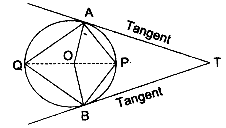
In the adjoining diagram TA and TB are tangents, O is the centre. If ∠ PAT = 35° and ∠ PBT = 40°.
Calculate:
(i) ∠ AQP, (ii) ∠ BQP
(iii) ∠ AQB, (iv) ∠ APB
(v) ∠ AOB, (vi) ∠ ATB
Find the lengths of the medians of a triangle whose vertices are $A (7,-3), B (5,3)$ and $C (3,-1)$.
Find the value of a for which the points $A(a, 3), B(2, 1)$ and $C(5, a)$ are collinear. Hence, find the equation of the line.