Question
Solve the following quadratic equation:$x^2 + 6x - (a^2 + 2a - 8) = 0$

Answer

$x^2 + 6x - (a^2 + 2a - 8) = 0$
$\Rightarrow x^2 + 6x - (a^2 + 4a - 2a - 8) = 0$
$\Rightarrow x^2 + 6x - [a(a + 4) - 2(a + 4)] = 0$
$\Rightarrow x^2+ 6x - (a + 4)(a - 2) = 0$
$\Rightarrow x^2 + (a + 4)x - (a - 2)x - (a + 4)(a - 2) = 0$
$\Rightarrow x[x + (a + 4)] - (a - 2)[x + (a + 4)] = 0$
$\Rightarrow [x + (a + 4)][x - (a - 2)] = 0$
$\Rightarrow x + (a + 4) = 0 or x - (a - 2) = 0$
$\Rightarrow x = -(a + 4) or x = (a - 2)$

Need a full question paper?

Generate a complete, print-ready paper with questions like this in minutes — across 16+ boards, with answer keys.
Start Generating Free

Similar questions

A school has invited $42$ Mathematics teachers, $56$ Physics teachers and $70$ Chemistry teachers to attend a Science workshop. Find the minimum number of tables required, if the same number of teachers are to sit at a table and each table is occupied by teachers of the same subject.
A solid sphere of radius 'r' is melted and recast into a hollow cylinder of uniform thickness. If the external radius of the base of the cylinder is $4\ cm$, its height $24\ cm$ and thickness 2cm, find the value of 'r'.
Prove the following trigonometric identities.
$(1+\cot\text{A}-\text{cosec A})(1+\tan\text{A}+\sec\text{A})=2$
The $4^{\text {th }}$ term of an AP is zero. Prove that its $25^{\text {th }}$ term is triple its $11^{\text {th }}$ term.
$\text{D, E, F}$ are respectively the mid-points of the sides $\text{A B, B C}$ and $C A$ of $\triangle A B C$. Find the ratios of area of $\triangle D E F$ and $\triangle A B C$.
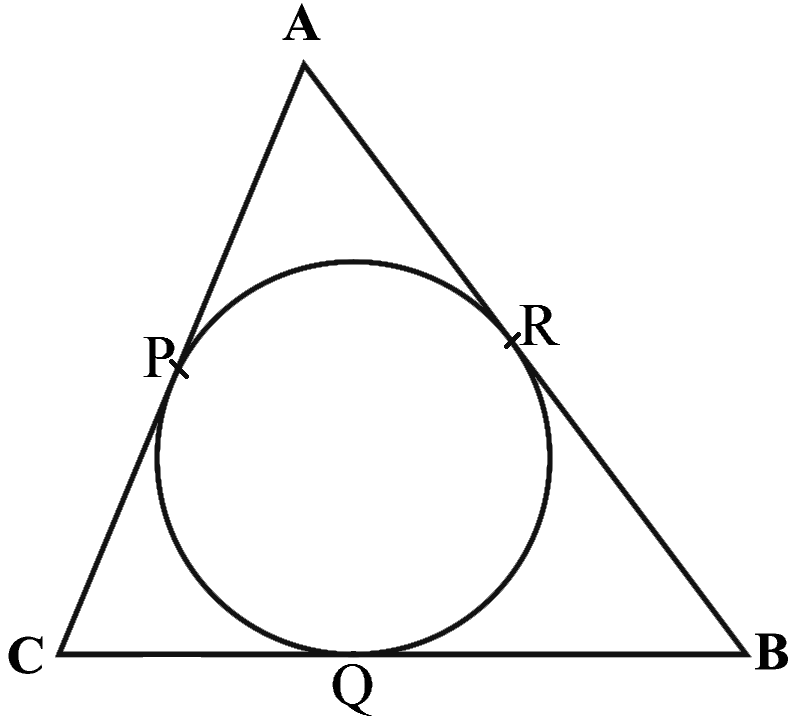
A circle is inscribed in a $\triangle\text{ABC}$ touching AB, BC and AC at P, Q and R respectively. If AB = 10cm, AR = 7cm and CR = 5cm, find the length of BC.
If $\alpha, \beta$ are zeroes of the quadratic polynomial $x ^2+3 x +2$, find a quadratic polynomial whose zeroes are $\alpha+1$, $\beta+1$
If $\sin \theta=\frac{3}{5}$, evaluate $\frac{\operatorname{cosec} \theta-\cot \theta}{2 \cot \theta}$
For the following, find a quadratic polynomial whose sum and product respectively of the zeroes are as given. Also, find the zeroes of these polynomials by factorization.
$-\frac{8}{3},\frac{4}{3}$
Determine the $AP$ whose fifth term is $19 $and the difference of the eighth term from the thirteenth term is $20.$