Question
Solve the following quadratic equation:$x^2 + 6x - (a^2 + 2a - 8) = 0$

Answer

$x^2 + 6x - (a^2 + 2a - 8) = 0$
$\Rightarrow x^2 + 6x - (a^2 + 4a - 2a - 8) = 0$
$\Rightarrow x^2 + 6x - [a(a + 4) - 2(a + 4)] = 0$
$\Rightarrow x^2+ 6x - (a + 4)(a - 2) = 0$
$\Rightarrow x^2 + (a + 4)x - (a - 2)x - (a + 4)(a - 2) = 0$
$\Rightarrow x[x + (a + 4)] - (a - 2)[x + (a + 4)] = 0$
$\Rightarrow [x + (a + 4)][x - (a - 2)] = 0$
$\Rightarrow x + (a + 4) = 0$ or $x - (a - 2) = 0$
$\Rightarrow x = -(a + 4)$ or $x = (a - 2)$

Need a full question paper?

Generate a complete, print-ready paper with questions like this in minutes — across 16+ boards, with answer keys.
Start Generating Free

Similar questions

Solve the following examples.
Find the length a diagonal of a rectangle having sides 11 cm and 60cm.
If 5 sec θ – 12 cosec θ = 0, then find values of sin θ, sec θ
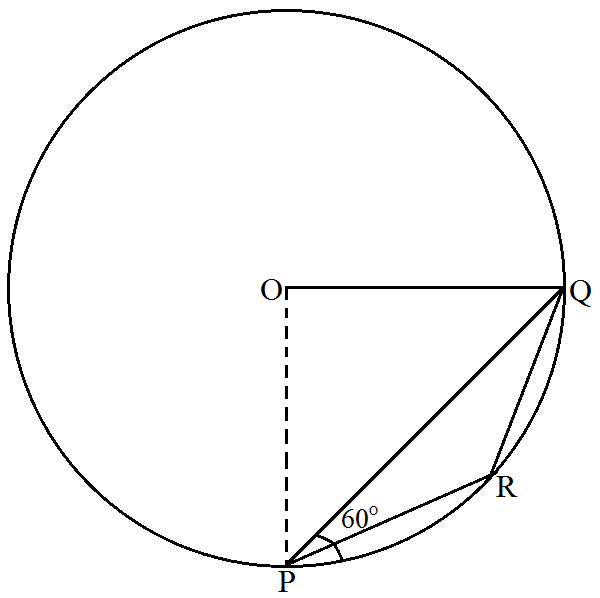
In the figure, PQ is a chord of a circle and PT is the tangent at P such that $\angle\text{QPT}=60^{\circ}.$ Then, find $\angle\text{PRQ}$.
Verify that points P(-2, 2), Q(2, 2) and R(2, 7) are vertices of a right angled triangle.

Find the value of a and b for which the following systems of linear equations has an infinite number of solutions:
$2x - 3y = 7,$
$(a + b)x - (a + b - 3)y = 4a + b$
The following are quadratic equations in x?
$\Big(\text{x}+\frac{1}{\text{x}}\Big)^2=2\Big(\text{x}+\frac{1}{\text{x}}\Big)+3$
From the given information, prepare the tax invoice for Business to Business (B2B). Write any name, address, date, etc.
Supplier : Name, Address, State, GSTIN, Invoice number, date
Receiver : Name, address, State, GSTIN
Name of products:
(i) Compass box : 100, HSN 3497, ₹ 60 , GST 12 %
(ii) Writing Pads : 50, HSN 9607, ₹ 35, GST 12 %
Make a list of ten things you need in your daily life. Find the GST rates with the help of GST rate chart given in the textbook, news papers or books, internet, or the bills of purchases. Verify these rates with the list prepared by your friends.
The faces of a die bear numbers 0, 1, 2, 3, 4, 5. If the die is rolled twice, then find the probability that the product of digits on the upper face is zero.

From a solid cube of side $7\ cm$, a conical cavity of height $7\ cm$ and radius $3\ c$m is hollowed out. Find the volume of the remaining solid.