Question
Solve the following quadratic equations by factorization:
$\frac{16}{\text{x}}-1=\frac{15}{\text{x}+1},$ $\text{x}\neq0,-1$

Answer

$\frac{16}{\text{x}}-1=\frac{15}{\text{x}+1}$
$\Rightarrow​​\frac{16-\text{x}}{\text{x}}-\frac{15}{\text{x}+1}$
$ \Rightarrow 16 x+16-x^2-x=15 x $
$ \Rightarrow-x^2+16+15 x=15 x $
$ \Rightarrow-x^2+16=0 $
$ \Rightarrow x^2-16=0 $
$ \Rightarrow(x-4)(x+4)=0 $
$ \Rightarrow x-4=0 \text { or } x+4=0 $
$ \Rightarrow x=4 \text { or } x=-4$
Hence, the factors are 4 and -4

Need a full question paper?

Generate a complete, print-ready paper with questions like this in minutes — across 16+ boards, with answer keys.

Start Generating Free

Similar questions

Find the zeros of the following quadratic polynomial and verify the relationship between the zeros and their coefficients:
$f(x) = x^2- 2x - 8$
The following table shows the daily wages of workers in a factory:
Daily wages (in Rs). $0-100$ $100-200$ $200-300$ $300-400$ $400-500$
Number of workers. $40$ $32$ $48$ $22$ $8$
Find the median daily wage income of the workers.
Two years ago, a man's age was three times the square of his son's age. In three years time, his age will be four times his son's age. Find their present ages.
Find the roots of the following quadratic equation (if they exist) by the method of completing the square.
$\text{x}^2-4\sqrt{2\text{x}}+6=0$
Find the next five terms of the following sequences given:
$a_1=4, a_n=4 a_{n-1}+3, n > 1$.
Find four numbers in $AP$ whose sum is $28$ and the sum of whose squares is $216.$
Solve the following systems of equations:
$\frac{1}{3\text{x}+\text{y}}+\frac{1}{3\text{x}-\text{y}}=\frac{3}{4}$
$\frac{1}{2(3\text{x}-\text{y})}+\frac{1}{2(3\text{x}-\text{y})}=\frac{-1}{8}$
If $S_n$ denotes the sum of first n terms of an $A.P.$, prove that $S_{12}= 3(S_8- S_4).$
A chord of a circle of radius $14\ cm$ makes a right angle at the centre. Find the areas of the minor and major segments of the circle.
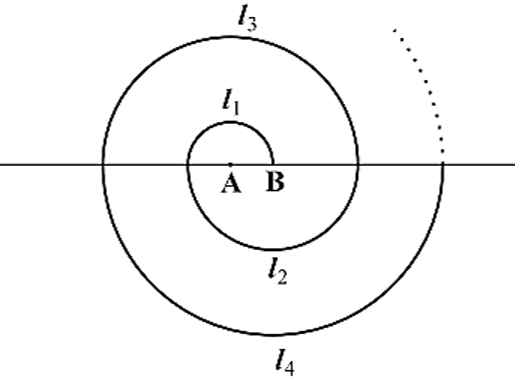
A spiral is made up of successive semicircles, with centres alternately at $A$ and $B,$ starting with centre at $A,$ of radii $0.5\ cm, 1.0\ cm, 1.5\ cm, 2.0\ cm, ...$ as shown in Figure. What is the total length of such a spiral made up of thirteen consecutive semicircles? $(Take\; \pi = \frac { 22 } { 7 } )$
$[$Hint: Length of successive semicircles is $l_1, l_2, l_3, l_4, ...$ with centres at $A, B, A, B, ... $ respectively.$]$​​​​​​​
Image