Question
Solve the following quadratic equations by factorization:
$2x^2 + ax - a^2 = 0$

Answer

$2x^2 + ax - a^2 = 02x^2 + 2ax - ax - a^2 = 0$
$2x(x + a) - a(x + a) = 0$
$(x + a)(2x - a) = 0$
$x + a = 0$ or $2x - a = 0$
$x = -a$ or $\text{x}=\frac{\text{a}}{2}$
Alternate Answer
First calculate $D = b^2 - 4ac$
Then apply $\text{x} = {-\text{b} \pm \sqrt{\text{D}} \over 2\text{a}}$
We get $x = -a$, $\text{x}=\frac{\text{a}}{2}$

Need a full question paper?

Generate a complete, print-ready paper with questions like this in minutes — across 16+ boards, with answer keys.

Start Generating Free

Similar questions

During the medical check-up of 35 students of a class, their weights were recorded as follows:
Weight (in kg)
No. of students
Less than 38
0
Less than 40
3
Less than 42
5
Less than 44
9
Less than 46
14
Less than 48
28
Less than 50
32
Less than 52
35
Draw a less than type ogive for the given data. Hence, obtain the median weight from the graph and verify the result by using the formula
The slant height of the frustum of a cone is $5\ cm$. If the difference between the radii of its two circular ends is $4\ cm$, write the height of the frustum.
The arithmetic mean of the following data is 25, find the value of k.
x 5 15 25 35 45
f 3 k 3 6 2
Solve the following simultaneous equation graphically.
5x – 6y + 30 = 0; 5x + 4y – 20 = 0
A spherical shell of lead, whose external diameter is $18\ cm$, is melted and recast into a right circular cylinder, whose height is $8\ cm$ and diameter $12\ cm$. Determine the internal diameter of the shell.
If $\alpha$ and $\beta$ are the zeroes of the quadratic polynomial $f(x) = ax^2 + bx + c,$ then evaluate:$\frac{1}{\text{a}\alpha+\text{b}}+\frac{1}{\text{a}\beta+\text{b}} $
The surface area of a sphere is $616\ cm^2$​​​​​​​. Find its radius.
The difference of two numbers is $4$. If the difference of their reciprocal is $\frac{4}{21},$ find the numbers.
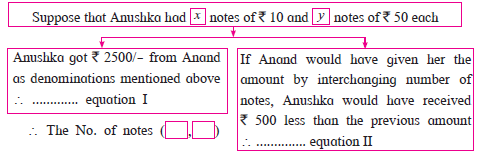
To find number of notes that Anushka had, complete the following activity
Prove that $\frac{\sin \theta}{\sec \theta+1}+\frac{\sin \theta}{\sec \theta-1}=2 \cot \theta$