Question
Solve the following quadratic equations by factorization:
$4\sqrt{3}\text{x}^2+5\text{x}-2\sqrt{3}=0$

Answer

We have been given
$4\sqrt{3}\text{x}^2+5\text{x}-2\sqrt{3}=0$
$4\sqrt{3}\text{x}^2+8\text{x}-3\text{x}-2\sqrt{3}=0$
$4\text{x}\big(\sqrt{3}\text{x}+2\big)-\sqrt{3}\big(\sqrt{3}\text{x}+2\big)=0$
$\big(\sqrt{3}\text{x}+2\big)\big(4\text{x}-\sqrt{3}\big)=0$
Therefore,
$\sqrt{3}\text{x}+2=0$
$\sqrt{3}\text{x}=-2$
$\text{x}=\frac{-2}{\sqrt{3}}$
or, $4\text{x}-\sqrt{3}=0$
$4\text{x}=\sqrt{3}$
$\text{x}=\frac{\sqrt{3}}{4}$
Hence, $\text{x}=\frac{-2}{\sqrt{3}}$ or $\text{x}=\frac{\sqrt{3}}{4}$

Need a full question paper?

Generate a complete, print-ready paper with questions like this in minutes — across 16+ boards, with answer keys.
Start Generating Free

Similar questions

Solve the following systems of equations:
$\frac{44}{\text{x}+\text{y}}+\frac{30}{\text{x}-\text{y}}=10,$
$\frac{55}{\text{x}+\text{y}}+\frac{40}{\text{x}-\text{y}}=13.$
Solve the following systems of equations:
x - y + z = 4,
x - 2y - 2z = 9,
2x + y + 3z = 1.
Each of the equal sides of an isosceles triangle measures 2cm more than its height, and the base of the triangle measures 12cm. Find the area of the triangle.
From a cubical piece of wood of side $21 \ cm ,$ a hemisphere is carved out in such a way that the diameter of the hemisphere is equal to the side of the cubical piece. Find the surface area and volume of the remaining piece.
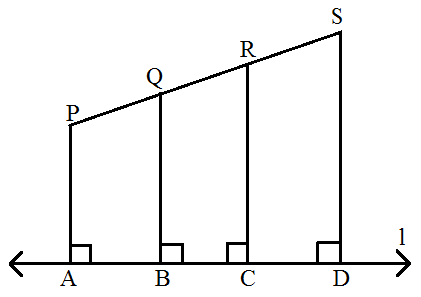
In PA, QB, RC and SD are all perpendiculars to a line l, AB = 6cm, BC = 9cm, CD = 12cm and SP = 36cm. Find PQ, QR and RS.
Find the sum of the integers between 100 and 200 that are-
Divisible by 9.
If a line is drawn parallel to one side of a triangle to intersect the other two sides in distinct points, then prove that the other two sides are divided in the same ratio.
Find the value of k for which each of the following system of equations have infinitely many solutions:
$2x - 3y = 7$
$(k + 2)x - (2k + 1)y = 3(2k - 1)$
A solid toy is in the form of a hemisphere surmounted by a right circular cone. Ratio of the radius of the cone to its slant height is $3: 5$. If the volume of the toy is $240 \pi cm^3$, then find the total height of the toy.
A container, open at the top and made up of metal sheet, is in the form of a frustum of a cone of height 16cm with diameters of its lower and upper ends as 16cm and 40cm, respectively. Find the cost of metal sheet used to make the container, if it costs ₹ 10 per $100cm^2.$