Question
Solve the following quadratic equations by factorization:
$9 x^2-3 x-2=0$

Answer

We have
$9 x^2-3 x-2=0$
$\Rightarrow 9 x^2-6 x+3 x-2=0$
$\Rightarrow 3 x(3 x-2)+1(3 x-2)=0$
$\Rightarrow(3 x-2)(3 x+1)=0$
$\Rightarrow \text { either } 3 x-2=0 \text { or } 3 x+1=0$
$\Rightarrow 3 x=2 \text { or } 3 x=-1$
$\Rightarrow\text{x}=\frac{2}{3}$ or $\text{x}=-\frac{1}{3}$
Thus, $\text{x}=\frac{2}{3}$ and $\text{x}=-\frac{1}{3}$ are two roots of the equation $9 x^2-3 x-2=0$

Need a full question paper?

Generate a complete, print-ready paper with questions like this in minutes — across 16+ boards, with answer keys.

Start Generating Free

Similar questions

In a potato race, a bucket is placed at the starting point, which is $5\ m$ from the first potato, and other potatoes are placed $3\ m$ apart in a straight line. There are n potatoes in the line (See Fig.).

A competitor starts from the bucket, picks up the nearest potato, runs back with it, drops it in the bucket, runs back to pick up the next potato, runs to the bucket to drop it in, and she continues in the same way until all the potatoes are in the bucket. What is the total distance the competitor has to run?
$[$Hint: To pick up the first potato and the second potato, the total distance (in metres) run by a competitor is $2 \times  5 + 2   \times (5 + 3)]$
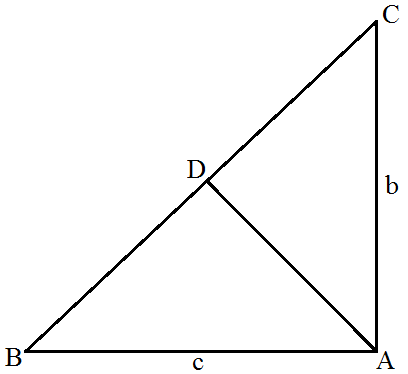
Using Pythagoras theorem determine the length of $AD$ in terms of $b$ and $c$ shown in the given figure.
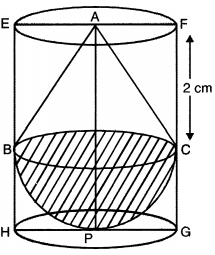
A solid toy is in the form of a hemisphere surmounted by a right circular cone. The height of the cone is $2 \ cm$ and the diameter of the base is $4 \ cm.$ Determine the volume of the toy. If a right circular cylinder circumscribes the toy, find the difference of the volume of the cylinder and toy. $($Take $\pi = 3.14)$
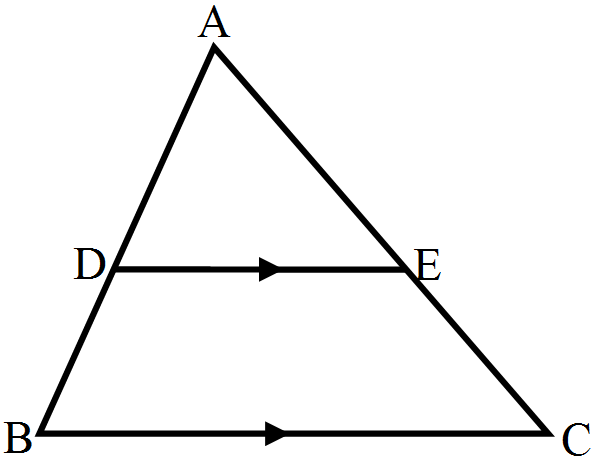
$D$ and $E$ are points on the sides $AB$ and $AC$ respectively of a $\triangle\text{ABC}$ such that $DE || BC:$
If $AD = 3.6\ cm, AB = 10\ cm$ and $AE = 4.5\ cm$, find $EC$ and $AC.$
Two cubes each of volume $27cm^3$ are joined end to end to form a solid. Find the surface area of the resulting cuboid.
Find the ratio in which the point $\text{P}\Big(\frac{3}{4},\frac{5}{12}\Big)$ divides the line segment joining the points $\text{A}\Big(\frac{1}{2},\frac{3}{2}\Big)$ and $B(2, -5).$
A survey was conducted by a group of students as a part of their environmental awareness programme, in which they collected the following data regarding the number of plants in $20$ houses in a locality. Find the mean number of plants per house.
Number of plants $0-2$ $2-4$ $4-6$ $6-8$ $8-10$ $10-12$ $12-14$
Number of houses $1$ $2$ $1$ $5$ $6$ $2$ $3$
Which method did you use for finding the mean, and why?
$12$ defective pens are accidently mixed with $132$ good ones. It is not possible to just look at pen and tell whether or not it is defective. one pen is taken out at random from this lot. Determine the probability that the pen taken out is good one.
Which term of the $A.P. 3, 15, 27, 39, ...$ will be $120$ more than its $21^{st}$ term$?$
Solve the following equations by using the method of completing the square:
$ x^2-4 x+1=0 $