Question
Solve the following quadratic equations by factorization:
$ax^2 + (4a^2 - 3b)x - 12ab = 0$
Answer

We have,
$ax^2 + (4a^2 - 3b)x - 12ab = 0$
$[a \times 12ab = -12a^2b^2 = 4a^2 \times -3b]$
$\Rightarrow ax^2 + 4a^2x - 3bx + (4a \times (-3b)) = 0$
$\Rightarrow ax(x + 4a) - 3b(x + 4a) = 0$
$\Rightarrow (x + 4a)(ax - 3b) = 0$
$\Rightarrow (x + 4a) = 0 or (ax - 3b) = 0$
⇒ x = -4a or $\text{x}=\frac{3\text{b}}{\text{a}}$
$\therefore\text{x}=\frac{3\text{b}}{\text{a}}$ and x = -4a are the two roots of the given equations.

Need a full question paper?

Generate a complete, print-ready paper with questions like this in minutes — across 16+ boards, with answer keys.

Start Generating Free

Similar questions

A bag contains 4 red, 5 black and 6 white balls. A ball is drawn from the bag at random. Find the probability that the ball drawn is:
  1. White.
  2. Red.
  3. Not black.
  4. Red or white.
Solve the following equations by using the method of completing the square:
$\sqrt3\text{x}^2+10\text{x}+7\sqrt3=0$
Two triangles ABC and PQR are such that AB = 3cm, AC = 6cm, $\angle\text{A}=70^\circ,\text{PR}=9\text{cm},\angle\text{P}=70^\circ$ and $\text{PQ}=4.5\text{cm}.$ show that $\triangle\text{ABC}\sim\triangle\text{PQR}$ and state the similarity criterion.
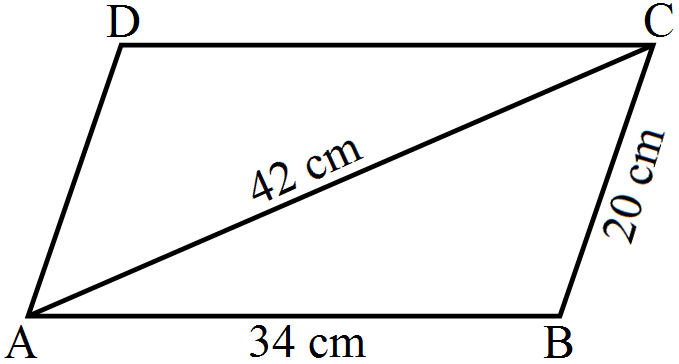
The adjacent sides of a parallelogram ABCD measure 34cm and 20cm, and the diagonal AC measures 42cm. Find the area of the parallelogram.
ABCD is a rectangle whose three vertices are B(4, 0), C(4, 3) and D(0, 3). Find the length of one of its diagonal.
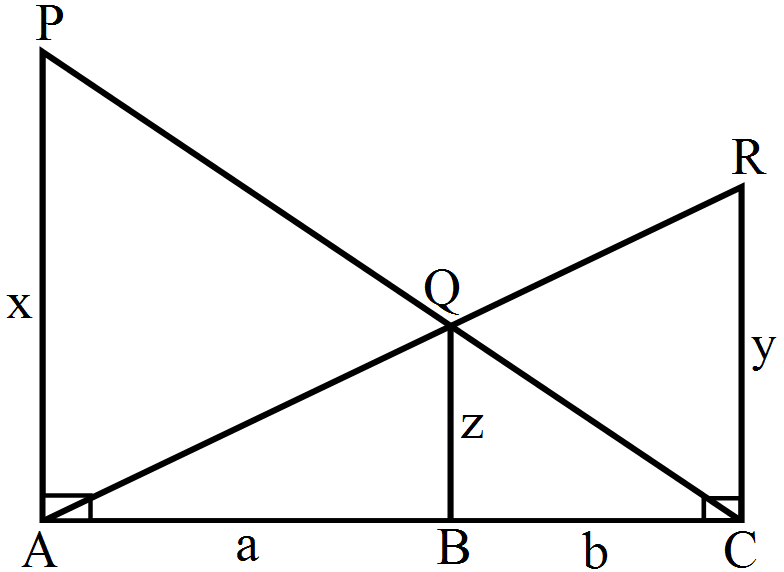
In the given figure, each one of PA , QB and RC is perpendicular to AC. If AP = x, QB = z, RC = y, AB = a and BC = b, show that $\frac{1}{\text{x}}+\frac{1}{\text{y}}=\frac{1}{\text{z}}.$
Very-Short-Answer Question:
If (a - b), a and (a + b) are zeros of the polynomial $2x^3 - 6x^2 + 5x - 7$, write the value of a.
In a $\triangle\text{ABC},\angle\text{B}=90^\circ,\angle\text{AB}=12\text{cm}$ and BC = 5cm.
Find:
  1. $\cos\text{A}$
  2. $\text{cosec}\text{A}$
  3. $\cos\text{C}$
  4. $\text{cosec}\text{C}.$
A tower stands vertically an the ground.From a point on the ground which is 20m away from the foot f the tower, th angle of elevation of its top is found tobe 60°. Find theh ight of the tower. $\big[\text{Take}\sqrt{3}=1.732\big]$
If a, b, c, are real numbers such that $\text{ac}\neq0,$ then show that at least one of the equations $ax^2+ bx + c = 0$ and $-ax^2 + bx + c = 0$ has real roots.