Question
Solve the following quadratic equations by factorization:
$\frac{\text{x}-\text{a}}{\text{x}-\text{b}}+\frac{\text{x}-\text{b}}{\text{x}-\text{a}}=\frac{\text{a}}{\text{b}}+\frac{\text{b}}{\text{a}}$
Answer

$\frac{\text{x}-\text{a}}{\text{x}-\text{b}}+\frac{\text{x}-\text{b}}{\text{x}-\text{a}}=\frac{\text{a}}{\text{b}}+\frac{\text{b}}{\text{a}}$
$\Rightarrow\frac{\text{x}-\text{a}}{\text{x}-\text{b}}-\frac{\text{a}}{\text{b}}=\frac{\text{b}}{\text{a}}-\frac{\text{x}-\text{b}}{\text{x}-\text{a}}$
$\Rightarrow\frac{\text{bx}-\text{ab}-\text{ax}+\text{ab}}{\text{b}(\text{x}-\text{b})}=\frac{\text{bx}-\text{ab}-\text{ax}+\text{ab}}{\text{a}(\text{x}-\text{a})}$
$\Rightarrow\frac{\text{bx}-\text{ax}}{\text{b}(\text{x}-\text{b})}=\frac{\text{bx}-\text{ax}}{\text{a}(\text{x}-\text{a})}$
$\Rightarrow\frac{\text{bx}-\text{ax}}{\text{b}(\text{x}-\text{b})}-\frac{\text{bx}-\text{ax}}{\text{a}(\text{x}-\text{a})}=0$
$\Rightarrow(\text{bx}-\text{ax})\bigg(\frac{1}{\text{b}(\text{x}-\text{b})}-\frac{1}{\text{a}(\text{x}-\text{a})}\bigg)=0$
$\Rightarrow(\text{b}\text{x}-\text{ax})\bigg(\frac{\text{a}(\text{x}-\text{a})-\text{b}(\text{x}-\text{b})}{\text{a}\text{b}(\text{x}-\text{a})(\text{x}-\text{b})}\bigg)=0$
$\Rightarrow\frac{\text{x}(\text{b}-\text{a})(\text{ax}-\text{bx}-\text{a}^2+\text{b}^2)}{\text{ab}(\text{x}-\text{a})(\text{x}-\text{b})}=0$
$\because\text{x}\neq\text{a},\text{x}\neq\text{b}$
(Division by Zero is not possible)
$\therefore\text{x}(\text{ax}-\text{bx}-\text{a}^2+\text{b}^2)=0$
Either $\text{x}=0$
or $\text{ax}-\text{bx}=\text{a}^2-\text{b}^2$
$\Rightarrow(\text{a}-\text{b})\text{x}=(\text{a}+\text{b})(\text{a}-\text{b})$
$\Rightarrow\text{x}=\frac{(\text{a}+\text{b})(\text{a}-\text{b})}{\text{a}-\text{b}}=\text{a}+\text{b}$
Hence, $\text{x}=0,\text{a}+\text{b}$

Need a full question paper?

Generate a complete, print-ready paper with questions like this in minutes — across 16+ boards, with answer keys.

Start Generating Free

Similar questions

A train, travelling at a uniform speed for 360km, would have taken 48 minutes less to travel the same distance if its speed were 5km/hr more. Find the original speed of the train.
A ship of height 24 m is sighted from a lighthouse. From the top of the lighthouse, the angle of depression to the top of the mast and base of the ship is 30 and 45 respectively. How far is the ship from the lighthouse? $(\sqrt{3}=1.73)$
The diameters of the front and rear wheels of a tractor are 80cm and 2m respectively. Find the number of volutions that a rear wheel makes to cover the distance which the front wheel covers in 800 revolutions,
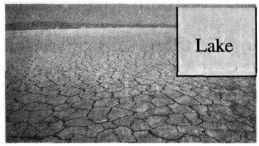
A missing helicopter is reported to have crashed somewhere in the rectangular region as shown in figure. What is the probability that it crashed inside the lake shown in the figure?
Image
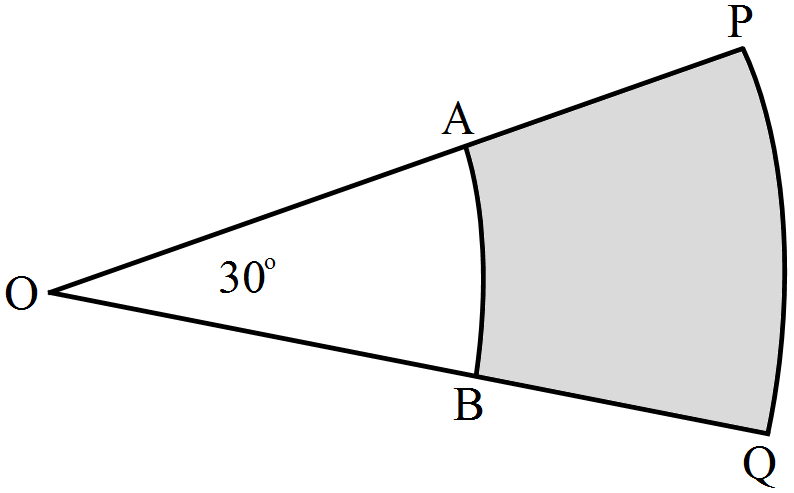
In the given figure, PQ and AB are respectively the arcs of two concentric circles of radii 7cm and 3.5cm with centre 0. If $\angle\text{POQ}=30^\circ,$ find the area of the shaded region.
The sum of a two-digit number and the number formed by reversing the order of digit is 66. If the two digits differ by 2, find the number. How many such numbers are there?
The three vertices of a parallelogram are (3, 4) (3, 8) and (9, 8). Find the fourth vertex.
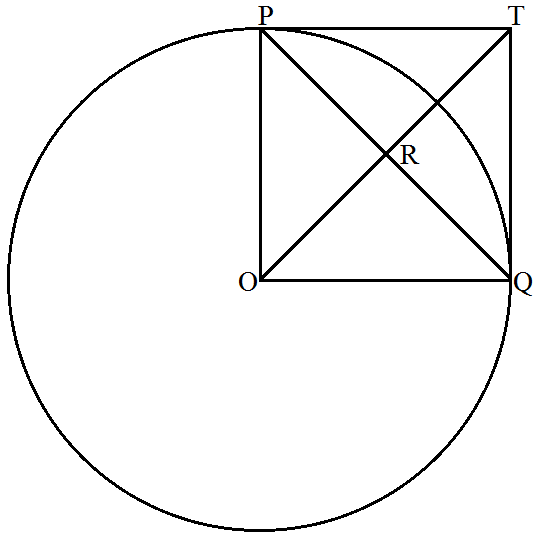
In the given figure,$\text{OP}\bot\text{OQ}.$ The tangents to the circle at P and Q intersect at a point T. Prove that PQ and OT are right bisector of each other.
From the top of a vertical tower, the angle of depression of two cars in the same straight line with the base of the tower, at an instant are found to be 45° and 60°. If the cars are 100m apart and are on the same side of the tower, find the height of the tower.
A straight road leads to the foot of a tower of height 50 m. From the top of the tower, the angle of depression of two cars standing on the road are 30 and 60. What is the distance between the two cars?